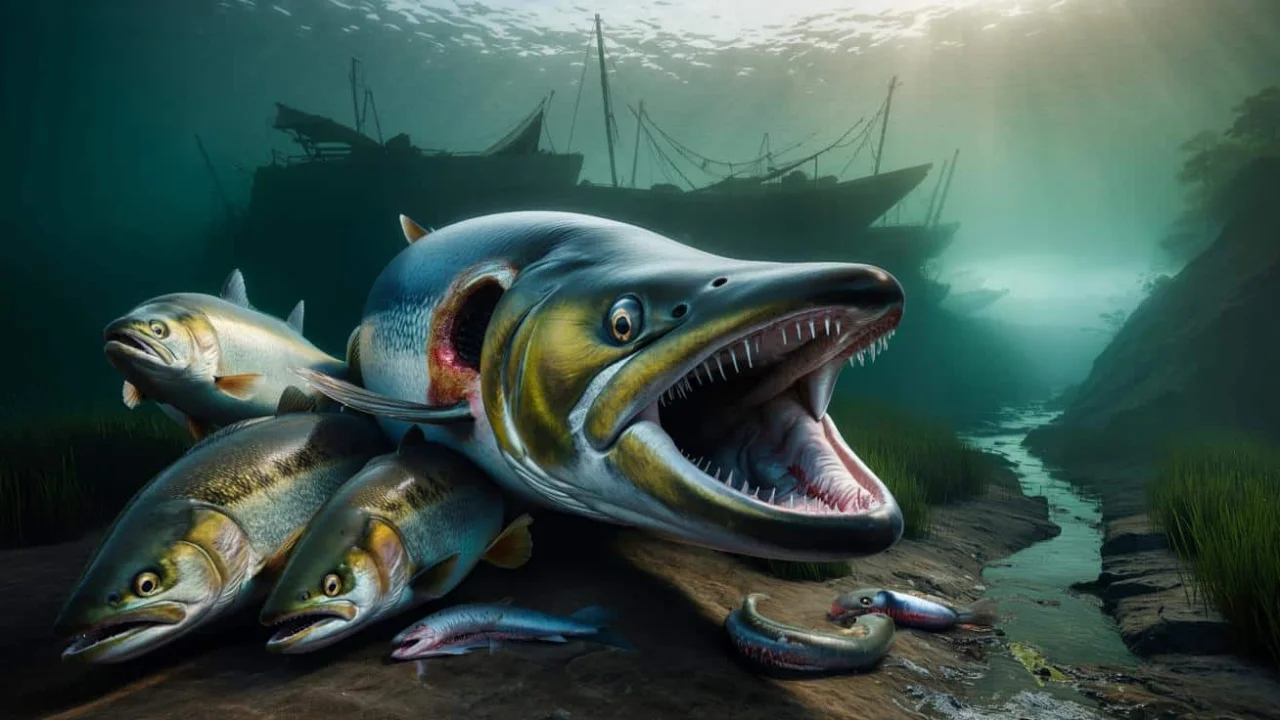
Captain Jim Sorensen still remembers the morning in 1985 when he pulled up his nets on Lake Michigan and found something that made his blood run cold. Instead of the usual haul of lake trout, his nets were filled with grotesque, eel-like creatures latched onto dying fish. “I’d been fishing these waters for twenty years,” he recalls, “but I’d never seen anything like those lamprey scars. Fish with holes in them, barely alive, worthless for market.”

What Jim witnessed that day was the peak of the sea lamprey invasion—one of the most devastating ecological disasters in North American freshwater history. By the 1950s, these ancient parasites had turned the Great Lakes into their personal feeding ground, wiping out entire fish populations and destroying livelihoods that had sustained communities for generations.
The sea lamprey invasion began quietly in the early 1900s, but its impact would reshape the Great Lakes ecosystem forever. Today, while the crisis has been largely controlled, these prehistoric predators still lurk in tributaries and rivers, serving as a reminder of how quickly an invasive species can change everything.

The Monster That Time Forgot
If you’ve never seen a sea lamprey up close, consider yourself lucky. These creatures look like something from a nightmare—ancient, jawless fish that have remained virtually unchanged for over 400 million years, predating dinosaurs by a significant margin.
Adult sea lampreys grow up to 47 inches long, resembling slender eels with smooth, scaleless skin. But the real horror show happens at their mouth: a circular, suction-cup opening lined with concentric rows of razor-sharp teeth and a rasping tongue that can bore through fish scales and skin like a biological drill.

“When people see that circular mouth for the first time, they usually take a step back,” explains Dr. Michael Hansen, a fisheries biologist with the Great Lakes Fishery Commission. “It’s designed for one purpose—latching onto other fish and feeding on their blood and bodily fluids.”
The feeding process is as brutal as it sounds. A lamprey attaches to a host fish using its suction-cup mouth, then uses its rasping tongue to create a wound. It feeds on blood, other fluids, and soft tissues for weeks or months, often killing the host or leaving it too weakened to survive.

Devastation by the Numbers
The scale of destruction caused by the sea lamprey invasion was staggering. Here’s what these parasites accomplished during their peak years in the Great Lakes:
| Lake | Peak Lamprey Population | Fish Loss (Annual) | Economic Impact |
|---|---|---|---|
| Superior | ~85,000 adults | 15 million pounds | $50 million |
| Michigan | ~65,000 adults | 12 million pounds | $45 million |
| Huron | ~45,000 adults | 8 million pounds | $35 million |
| Erie | ~25,000 adults | 5 million pounds | $20 million |
| Ontario | ~20,000 adults | 4 million pounds | $15 million |
Each adult sea lamprey can consume or kill up to 18 kilograms (40 pounds) of fish during its 12-18 month feeding cycle. With hundreds of thousands of lampreys in the system, the mathematics of destruction were simple and devastating.

The invasion’s impact went far beyond raw numbers:
- Lake trout populations crashed by 99% in some areas
- Whitefish catches dropped from millions of pounds to nearly zero
- Commercial fishing operations collapsed across all five lakes
- Tourism revenue plummeted as sport fishing became nearly impossible
- Entire food webs were disrupted, affecting birds, marine mammals, and other fish species
“By the 1960s, we were looking at complete ecosystem collapse,” says Dr. Sarah Martinez, a marine invasion specialist. “The lamprey had essentially turned the Great Lakes into a killing field.”
Fighting Back Against an Ancient Enemy
The fight against sea lamprey invasion required unprecedented cooperation between the United States and Canada. The Great Lakes Fishery Commission, established in 1955, became the command center for what would become one of the most successful invasive species control programs in history.
The strategy focused on three main approaches: chemical control, physical barriers, and biological methods. Scientists developed TFM (3-trifluoromethyl-4-nitrophenol), a selective pesticide that targets lamprey larvae in streams while leaving most other aquatic life unharmed.
Physical barriers and traps were installed at key spawning locations, while researchers explored sterile male releases and pheromone disruption techniques. The coordinated assault worked—sea lamprey populations dropped by approximately 90% from their peak levels.
But the victory came with a price tag. The ongoing control program costs around $20 million annually and requires constant vigilance. “We can never let our guard down,” warns Dr. Hansen. “These creatures have survived mass extinctions. They’re not going away easily.”
Today, sea lampreys still inhabit Great Lakes tributaries and rivers, their populations kept in check through continued management efforts. While their numbers remain relatively low, scientists estimate that thousands of adult lampreys still call the Great Lakes home.
The invasion’s legacy lives on in changed ecosystems and fishing communities that never fully recovered. Some native fish species remain at fraction of their historical numbers, and the commercial fishing industry never regained its former prominence.
“We learned that prevention is always better than control,” reflects Dr. Martinez. “The sea lamprey invasion cost billions and took decades to manage. We can’t afford to make those mistakes again with new invasive species.”
FAQs
How did sea lampreys get into the Great Lakes?
They likely entered through the Welland Canal system in the early 1900s, which connected the lakes to the Atlantic Ocean where lampreys naturally occur.
Are sea lampreys dangerous to humans?
No, sea lampreys don’t attack humans. They specifically target fish and have never been known to harm swimmers or divers.
Can sea lampreys be completely eliminated from the Great Lakes?
Complete elimination is unlikely due to their ability to hide in tributaries and reproduce quickly. The focus remains on population control.
How much does it cost to control sea lampreys annually?
The Great Lakes Fishery Commission spends approximately $20 million per year on lamprey control efforts across all five lakes.
What fish species were most affected by the lamprey invasion?
Lake trout and whitefish suffered the most severe population crashes, with some areas seeing 99% declines in native fish populations.
Are there any benefits to having sea lampreys in the Great Lakes?
While they play a role in nutrient cycling, the ecological and economic damage they cause far outweighs any potential benefits in this non-native environment.
About the Author