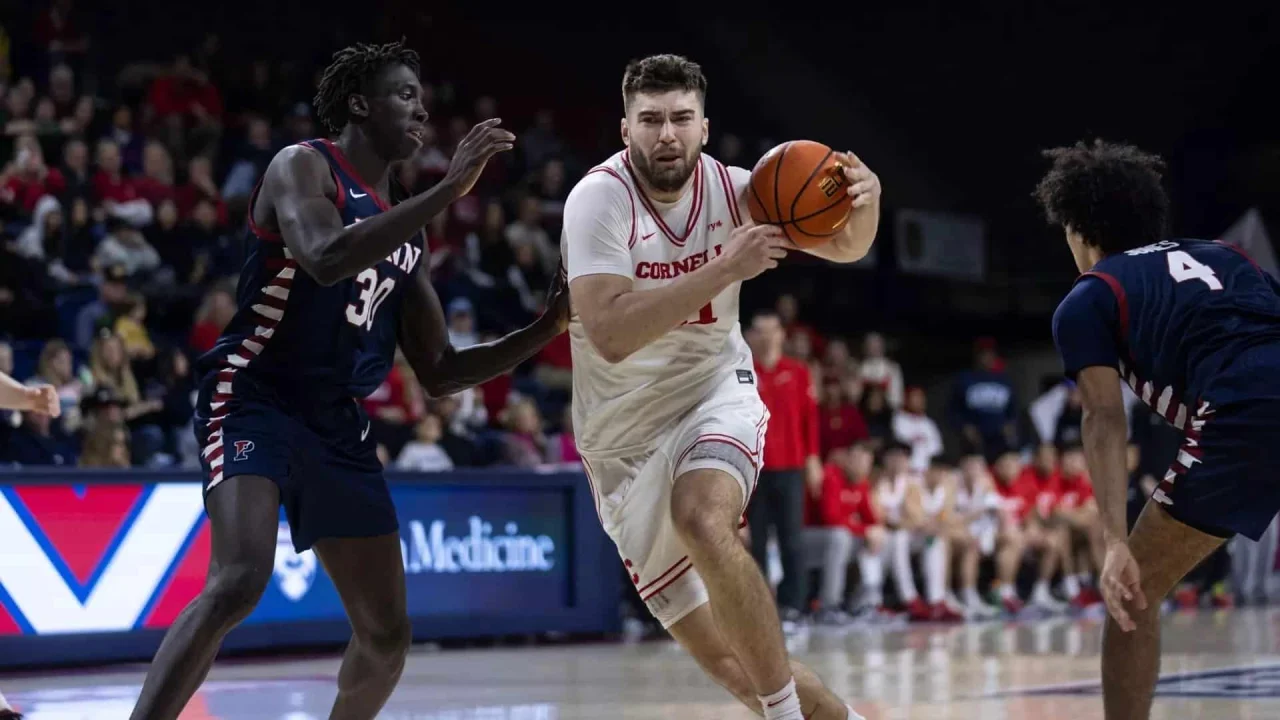
The buzzer echoed through Philadelphia’s historic Palestra as Jake Fiegen watched his last-ditch three-pointer fall through the net. For a moment, hope flickered in the Cornell section. Down by just five points with seconds remaining, maybe—just maybe—the Big Red could pull off something magical.

But sometimes basketball comes down to the fundamentals your coach preached since day one: take care of the ball and make your free throws. On this February night, those fundamentals became Cornell’s undoing.
The final score read 82-76 in favor of Penn, but the numbers on the stat sheet told the real story. Sixteen turnovers. Ten missed free throws. Those are the kinds of mistakes that haunt players long after they’ve left the court.
When Offensive Firepower Meets Defensive Pressure
Cornell mens basketball showcased their offensive depth in ways that would make any coach proud. Six different players reached double figures—a testament to the balanced attack that has defined this Big Red squad all season.
“Having six guys in double digits shows we can score with anyone in the league,” said a visibly frustrated Jake Fiegen after the game. “But you can’t win games when you’re giving the ball away that many times.”
Fiegen led the charge with 17 points and eight rebounds, playing with the intensity of a senior who knows his time in an Ivy League uniform is running short. Cooper Noard provided the outside shooting threat with 13 points, including three crucial three-pointers that kept Cornell within striking distance throughout the second half.
The supporting cast stepped up in impressive fashion. Adam Hinton, Jacob Beccles, Josh Baldwin, and Kaspar Sepp each contributed exactly 10 points—the kind of balanced scoring that usually translates to victories. Sepp pulled down eight rebounds while Hinton added seven, giving Cornell a slight 41-40 edge on the boards.
Cornell shot an impressive 47.6 percent from the field, numbers that typically spell success in Ivy League play. But basketball isn’t just about making shots—it’s about protecting the ball and converting at the charity stripe when the pressure mounts.
The Numbers That Tell the Real Story
Statistics rarely lie, and Saturday’s box score painted a clear picture of how this game slipped away from the Big Red. Here’s where the contest was truly won and lost:
| Category | Cornell | Penn |
|---|---|---|
| Field Goal % | 47.6% | 45.2% |
| Free Throw % | 47.6% (10-21) | 65.9% (27-41) |
| Turnovers | 16 | 12 |
| Points off Turnovers | 15 | 23 |
| Fast Break Points | 8 | 21 |
| Rebounds | 41 | 40 |
Penn’s Jay Jones and TJ Power each tallied 17 points, matching Fiegen’s output but with better support from the free-throw line. AJ Levine contributed 16 points while swiping five steals—many of which led directly to those crushing fast-break opportunities.
“Levine was everywhere tonight,” noted one courtside observer. “Every time Cornell tried to push the pace, he was there to disrupt their rhythm.”
The Quakers’ ability to convert mistakes into points proved decisive. Those 23 points off turnovers and 21 fast-break points created a cushion that Cornell’s offense, impressive as it was, couldn’t overcome.
Key factors that shaped the outcome:
- Cornell’s 16 turnovers led to 23 Penn points
- The Big Red shot just 47.6% from the free-throw line
- Penn’s 21 fast-break points came largely from live-ball turnovers
- AJ Levine’s five steals disrupted Cornell’s offensive flow
- Both teams struggled from three-point range, but Penn compensated with superior free-throw shooting
What This Loss Means for Cornell’s Season
The defeat drops Cornell mens basketball to 12-11 overall and 5-5 in Ivy League play, placing them squarely in the middle of the conference race. More concerning is Penn’s completion of the season sweep, eliminating potential tiebreaker advantages down the road.
“We’re not panicking, but we can’t afford many more games like this,” said one team source. “The Ivy League is too competitive to give away possessions like we did tonight.”
With the conference tournament picture taking shape, every game carries playoff implications. Cornell sits in a precarious position where they can neither afford to look past any opponent nor rely solely on their offensive capabilities to mask fundamental mistakes.
The Big Red’s balanced scoring attack remains their greatest strength. Having six players reach double figures demonstrates the depth that many Ivy League programs would envy. However, that offensive firepower means nothing if possessions are squandered through careless turnovers.
Penn’s improvement to 13-10 overall and 6-4 in conference play puts them in a much stronger position heading into the final stretch of the regular season. The Quakers have now won four of their last six games, with their only losses coming against league-leading teams.
For Cornell, the path forward requires addressing the turnover issues that have plagued them in crucial moments. Sixteen giveaways against a disciplined Penn defense represents a concerning trend that better teams will exploit even more ruthlessly.
The free-throw shooting woes—going just 10-of-21 from the line—reflect the kind of pressure situations that separate good teams from great ones. In a league where games are often decided by single possessions, converting free throws isn’t just important; it’s essential for survival.
“Basketball is a game of inches and details,” reflected assistant coach Mike Thompson after reviewing the film. “Tonight, those details got away from us when it mattered most.”
As Cornell prepares for their remaining conference games, the loss at Penn serves as both a wake-up call and a learning opportunity. The offensive talent is clearly there—six players in double figures doesn’t happen by accident. The question becomes whether they can clean up the mistakes that turned a winnable road game into another missed opportunity.
FAQs
What was the final score of the Cornell vs Penn game?
Penn defeated Cornell 82-76 in their Ivy League matchup at the Palestra.
Who led Cornell in scoring?
Jake Fiegen led Cornell with 17 points and eight rebounds, while Cooper Noard added 13 points including three three-pointers.
What were Cornell’s main problems in the loss?
Cornell struggled with 16 turnovers and poor free-throw shooting, going just 10-of-21 from the charity stripe.
How many Cornell players scored in double figures?
Six Cornell players reached double figures: Fiegen (17), Noard (13), and Hinton, Beccles, Baldwin, and Sepp (10 each).
What is Cornell’s current record?
Cornell now stands at 12-11 overall and 5-5 in Ivy League play after the loss to Penn.
Did Penn complete a season sweep of Cornell?
Yes, with this victory Penn completed the season sweep of Cornell, having won both meetings between the teams this year.
About the Author