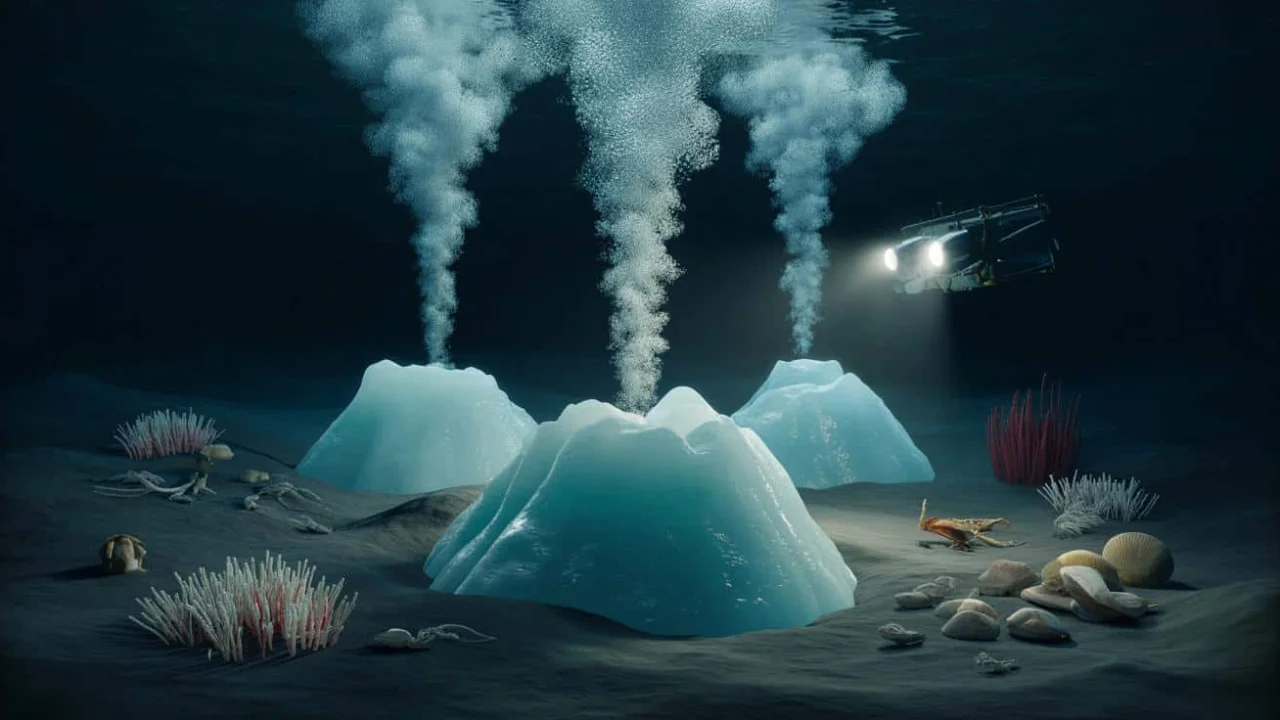
Picture yourself standing on a research vessel in the middle of the Greenland Sea, surrounded by nothing but dark, icy waters stretching to the horizon. The crew is buzzing with excitement as they stare at their sonar screens, watching something extraordinary unfold more than two miles beneath their feet. What they’re seeing shouldn’t exist—towering columns of gas shooting up from the deepest ocean floor, creating underwater geysers that reach heights taller than most skyscrapers.

This isn’t science fiction. It’s the remarkable discovery that’s reshaping what we know about our planet’s hidden energy reserves and the life forms that call the deep ocean home. The deepest gas hydrate vent on Earth has just been found, and its implications stretch far beyond the scientific community.
The discovery happened during the Ocean Census Arctic Deep expedition in 2024, when researchers were mapping the Molloy Ridge—a tectonic ridge sitting between Svalbard and Greenland. What started as routine seafloor mapping quickly turned into a groundbreaking moment when instruments detected massive plumes of methane bubbles rising from depths that seemed impossible for such activity.

What Makes This Gas Hydrate Vent So Special
At 3,640 meters below sea level, the newly discovered Freya Hydrate Mounds represent something unprecedented in ocean science. This gas hydrate vent system creates methane plumes that tower up to 3,355 meters above the seafloor—imagine underwater columns nearly as tall as three Empire State Buildings stacked on top of each other.
“We’re looking at depths that challenge everything we thought we knew about where these systems can exist,” explains Dr. Sarah Chen, a marine geochemist who studies deep-sea hydrate formations. “Finding active gas hydrate vents at this depth completely rewrites the textbook.”

Gas hydrates themselves are fascinating structures—imagine ice cubes, but instead of just frozen water, they’re crystalline cages where water molecules trap methane gas. These formations only exist under specific conditions of high pressure and low temperature, which is exactly what you find in the deep ocean.
The Freya site sits in what scientists call a “cold seep” zone, where hydrocarbon-rich fluids slowly leak through cracks in the seafloor. Unlike the dramatic hot springs of volcanic vents, these areas ooze chemicals that fuel entirely different types of ecosystems.

Breaking Down the Discovery: Key Facts and Figures
The scale and characteristics of this gas hydrate vent system reveal just how extraordinary this find really is:
- Location depth: 3,640 meters below sea level (previously, most hydrate vents were found at less than 2,000 meters)
- Plume heights: One column reaches 1,770 meters, another stretches 3,355 meters above the seafloor
- Geographic setting: Middle of an oceanic ridge, far from typical continental margins where such vents are usually found
- Primary gas composition: Methane trapped in ice-like crystal structures
- Discovery method: Advanced sonar mapping followed by remotely operated vehicle (ROV) confirmation

| Aspect | Freya Hydrate Mounds | Typical Gas Hydrate Vents |
|---|---|---|
| Depth | 3,640 meters | Usually under 2,000 meters |
| Location | Mid-oceanic ridge | Continental slopes |
| Plume Height | Up to 3,355 meters | Typically under 1,000 meters |
| Ecosystem Type | Chemosynthetic communities | Variable, depth-dependent |
What makes this discovery even more remarkable is the thriving ecosystem researchers found around the gas hydrate vent. Despite being in perpetual darkness at crushing depths, the area supports complex communities of organisms that derive energy from chemical processes rather than sunlight.
“The life forms we’re seeing down there are like nothing we expected at such depths,” notes marine biologist Dr. James Rodriguez. “They’re perfectly adapted to an environment that would be instantly fatal to most surface life, yet they’re thriving.”
Why This Changes Everything We Know About Energy and Climate
The implications of discovering the deepest gas hydrate vent extend far beyond academic curiosity. These findings could reshape global energy strategies and climate change predictions in ways most people haven’t considered.
Gas hydrates represent one of the largest untapped energy reserves on Earth. Some estimates suggest that hydrate deposits contain more carbon than all known fossil fuel reserves combined. The discovery of active vents at such extreme depths suggests these reserves might be far more extensive than previously believed.
For energy companies, this opens up entirely new possibilities—and challenges. Extracting gas from hydrates at such depths would require revolutionary technology and enormous investment. But the potential payoff could power entire nations for decades.
From a climate perspective, the news is more complex. Methane is a greenhouse gas roughly 25 times more potent than carbon dioxide. Understanding how much methane these deep vents release, and whether climate change might destabilize other hydrate deposits, becomes crucial for predicting future atmospheric conditions.
“Every new gas hydrate vent we discover helps us understand the planet’s carbon budget better,” explains climate researcher Dr. Maria Santos. “But it also raises new questions about how much methane might be locked away in places we haven’t even explored yet.”
The location of the Freya Hydrate Mounds also matters geopolitically. The Arctic region is already a focus of international interest due to melting ice opening new shipping routes and resource access. Discovering massive energy reserves in these waters adds another layer of complexity to Arctic governance and environmental protection efforts.
For fishing communities and marine ecosystems, these discoveries highlight how little we still know about deep ocean environments. The unique life forms around gas hydrate vents could hold keys to understanding evolution, developing new medicines, or even surviving in extreme environments on other planets.
The technology used to make this discovery—advanced sonar mapping and remotely operated vehicles—represents the cutting edge of ocean exploration. As these tools become more sophisticated and accessible, we’re likely to find more gas hydrate vents in unexpected places.
What happens next depends largely on international cooperation and environmental stewardship. The deep ocean remains one of the least understood environments on Earth, yet it may hold some of the most important answers to humanity’s energy and climate challenges.
FAQs
What exactly is a gas hydrate vent?
A gas hydrate vent is an underwater location where methane gas trapped in ice-like crystal structures seeps from the seafloor, creating plumes of gas bubbles that rise through the water column.
How deep is the deepest gas hydrate vent now known?
The newly discovered Freya Hydrate Mounds are located at 3,640 meters below sea level, making them the deepest known gas hydrate emissions on Earth.
Could these gas hydrates be used as an energy source?
Potentially yes, but extracting gas from hydrates at such extreme depths would require advanced technology that doesn’t currently exist and would be extremely expensive to develop.
Are there living creatures around these deep vents?
Yes, the area supports unique ecosystems of organisms that survive through chemosynthesis, deriving energy from chemical reactions rather than sunlight.
How do gas hydrate vents affect climate change?
These vents release methane, a potent greenhouse gas, into the ocean and potentially the atmosphere, making them important factors in understanding global carbon cycles and climate predictions.
Where exactly was this discovery made?
The gas hydrate vent was found on the Molloy Ridge in the Greenland Sea, located between Svalbard and Greenland in the Arctic Ocean.
About the Author
