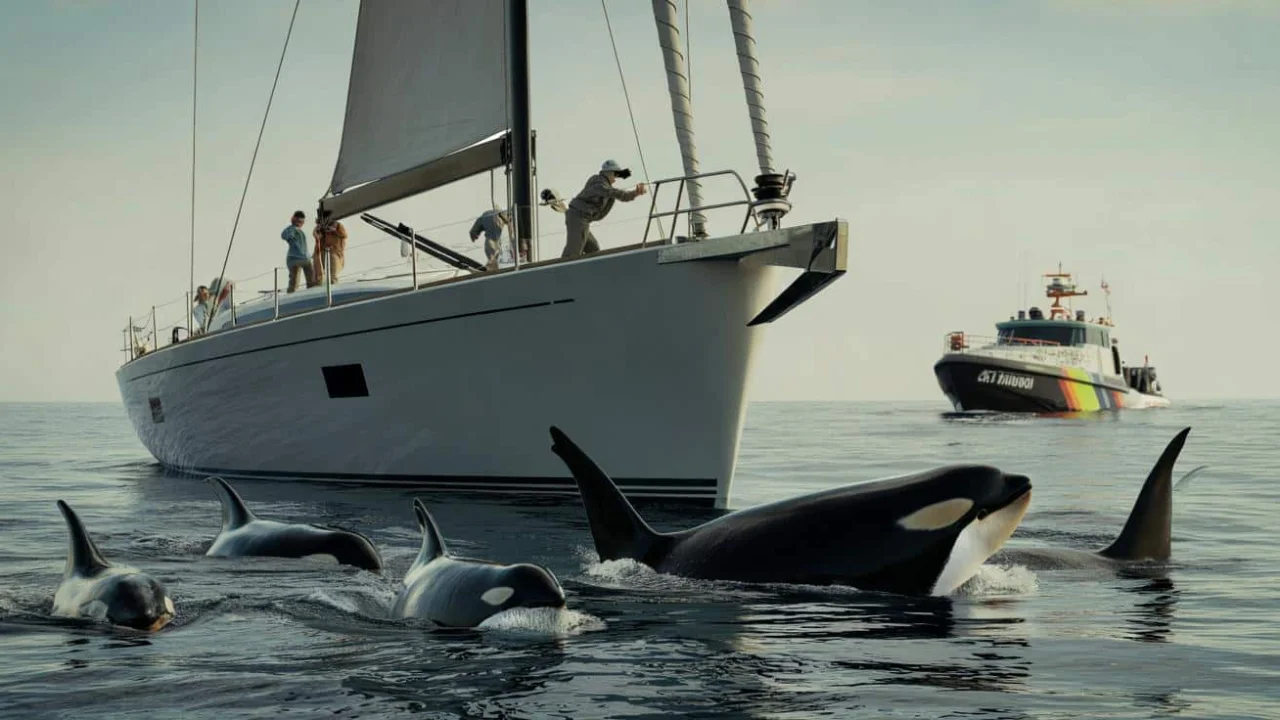
Captain Maria Santos felt the first jolt at 6:42 AM, just as she was enjoying her morning coffee on the deck of her 35-foot sailboat. The calm waters off Gibraltar suddenly erupted as something massive struck the rudder from below. Within minutes, three orcas surrounded her vessel, their distinctive black-and-white bodies moving with an intelligence that sent chills down her spine.

“They weren’t just bumping into us,” Santos recalls. “They were working together, taking turns ramming the rudder like they had a plan. I’ve sailed these waters for twenty years, and I’ve never seen anything like it.”
Two hours later, her rudder was destroyed, and she was waiting for a coast guard rescue. Santos had become another casualty in what marine biologists are calling an unprecedented wave of orca attacks on sailing vessels.

The “Rudder Gang” Phenomenon Sparks Deadly Debate
Since 2020, over 500 sailing vessels have reported aggressive encounters with orcas along the Iberian Peninsula. These aren’t random collisions or playful interactions. The attacks show disturbing patterns of coordination and persistence that have baffled scientists and terrified sailors.
Dr. Elena Rodriguez, a marine biologist studying the phenomenon, explains the behavior: “These orcas specifically target rudders and keels with surgical precision. They’ve learned that destroying these components disables the vessel completely.”

The behavior appears to have originated with a small group of orcas, possibly a single matriarchal pod, before spreading through social learning to other groups. Researchers have identified specific individuals, including a female nicknamed “White Gladis,” who seem to be teaching the technique to younger orcas.
“What we’re witnessing is cultural transmission in real-time,” explains Dr. Rodriguez. “Young orcas are learning this boat-disabling behavior from their mothers and pod members, then refining and passing it on to their own offspring.”

The situation has escalated to the point where Spanish and Portuguese maritime authorities are considering extreme measures. Internal documents reveal discussions about using electrical stunning devices and, in worst-case scenarios, culling individual orcas that pose repeated threats to vessels.
The proposals have ignited fierce controversy among conservationists, sailors, and government officials. Environmental groups are calling the plans “barbaric” while yacht owners demand immediate action to protect their vessels and crew safety.

By the Numbers: Understanding the Scale of Orca Encounters
The data paints a stark picture of escalating marine conflicts that show no signs of slowing down. Recent statistics reveal the true scope of these unprecedented orca attacks.
| Year | Reported Incidents | Vessels Damaged | Total Vessels Sunk |
|---|---|---|---|
| 2020 | 52 | 48 | 2 |
| 2021 | 197 | 156 | 4 |
| 2022 | 207 | 178 | 3 |
| 2023 | 264 | 221 | 7 |
The pattern shows several concerning trends that maritime authorities can no longer ignore:
- Attacks are increasing by 25-30% annually
- Incidents now occur year-round, not just during migration seasons
- Multiple orca pods have learned the boat-disabling behavior
- Average repair costs per incident exceed €15,000
- Some areas report interaction rates of 1 in 4 vessels passing through
“We’re seeing behavior that’s completely outside normal orca patterns,” says Dr. Michael Thompson, who has studied killer whales for over two decades. “This appears to be learned behavior spreading through the population, which makes it incredibly difficult to predict or prevent.”
The geographic range has also expanded significantly. Initially concentrated around the Strait of Gibraltar, incidents now stretch from Morocco to France’s Bay of Biscay. Researchers have documented at least 15 different orca pods exhibiting the boat-attacking behavior, suggesting the technique has spread far beyond its original source.
Insurance companies have responded by creating specialized “orca damage” policies and dramatically increasing premiums for vessels sailing in affected waters. Some insurers now refuse coverage entirely for certain routes during peak interaction seasons.
Lloyd’s of London reports orca-related claims have increased by 400% since 2020, with total payouts exceeding €4.2 million in 2023 alone. Maritime insurance specialist Jennifer Wells notes, “We’re having to completely restructure risk assessments for the region. This isn’t a temporary anomaly – it’s become the new normal.”
The Science Behind the Behavior: Understanding Orca Intelligence
To understand why these orca attacks are so concerning to scientists, it’s crucial to grasp the sophisticated nature of orca society and learning capabilities. Killer whales possess the second-largest brains of any marine mammal and demonstrate problem-solving abilities that rival those of great apes.
Dr. Lara Brent, a cognitive ethologist specializing in cetacean behavior, explains: “Orcas have what we call ‘cultural ecotypes’ – different populations develop unique hunting techniques, communication patterns, and social behaviors. What we’re seeing with boat interactions represents the rapid emergence of a completely new cultural behavior.”
The learning process appears hierarchical. Matriarchs teach the technique to their daughters and sons, who then practice on boats while under supervision. Juvenile orcas have been observed making initial contact attempts while adults circle nearby, seemingly coaching their technique.
Video evidence shows orcas approaching boats with deliberate strategy. They often send scouts to assess the vessel before coordinating attacks. Some pods demonstrate role specialization, with certain individuals focusing on rudder destruction while others work to immobilize the boat by grabbing keels or disrupting steering.
“The sophistication is remarkable and terrifying,” admits Dr. Brent. “They’re not just randomly damaging boats – they’re systematically disabling them with surgical precision.”
Real-World Consequences: When Ocean Giants Meet Human Technology
The impact extends far beyond damaged boats and frustrated sailors. The orca attacks are reshaping maritime commerce, tourism, and conservation efforts across Southern Europe.
Charter companies report booking cancellations exceeding 40% for affected routes. The prestigious ARC Atlantic Rally for Cruisers has modified its traditional route to avoid high-risk areas, adding hundreds of nautical miles to the journey.
Sarah Mitchell, whose family operates a yacht charter business in Gibraltar, describes the devastating impact: “We’ve had to relocate three boats this season alone. Clients are terrified, and I don’t blame them. Insurance costs have tripled, and we’re losing bookings every week.”
The ripple effects extend throughout the maritime economy. Boat manufacturers report increasing demand for reinforced rudders and alternative steering systems. Marina operators in safe zones are experiencing unexpected surges in boat relocations, straining capacity and driving up berthing fees.
Commercial shipping hasn’t been immune either. While large cargo vessels rarely suffer serious damage, several freight companies have rerouted ships to avoid high-risk areas, adding fuel costs and delivery delays. The fishing industry has been particularly hard hit, with some fleets losing multiple vessels to orca encounters.
The proposed intervention methods being discussed include:
- Underwater acoustic deterrents to discourage approaches
- Electronic stunning devices for aggressive individuals
- Relocation programs for repeat offender pods
- Lethal intervention as a final resort for dangerous orcas
Each option carries significant challenges and ethical concerns. Acoustic deterrents might affect other marine life or simply teach orcas to ignore the sounds. Relocation could disrupt family structures and territorial boundaries. Electronic stunning raises questions about long-term neurological effects on highly intelligent animals.
Conservation groups have mobilized fierce opposition to any lethal measures. Dr. James Peterson from the International Whale Conservation Society warns: “Killing even a single orca could destabilize the entire pod structure. These are highly intelligent, social animals with complex family bonds.”
The debate has created unlikely alliances and bitter divisions. Some sailor organizations support stunning devices while opposing lethal measures. Others demand immediate action regardless of conservation concerns.
Captain Santos, who survived her encounter relatively unscathed, remains conflicted: “I love these animals, but I also love sailing. There has to be a way to coexist without anyone getting hurt – human or orca.”
Meanwhile, marine authorities face mounting pressure to act. Every week brings new incidents, and the question isn’t whether intervention will happen, but what form it will take. The clock is ticking as sailing season approaches, and both sides prepare for what could become the most controversial marine conservation battle in decades.
International Response and Future Implications
The orca situation has attracted attention from marine authorities worldwide, with experts worried about similar behaviors emerging in other regions. The International Whaling Commission has established a special task force to monitor the situation and develop response protocols.
Dr. Alexandra Chen, a marine mammal specialist with the European Marine Research Council, warns of broader implications: “If this behavior spreads to orca populations in other regions – say, the Pacific Northwest or Norwegian waters – we could face a global crisis in recreational boating and small-scale commercial fishing.”
Several countries have begun implementing emergency response measures. France has deployed additional coast guard vessels along its Atlantic coast, while Morocco has issued official sailing advisories for the Strait of Gibraltar. Portugal is considering establishing “orca-free” shipping lanes for essential maritime traffic.
The situation has also sparked innovation in marine technology. Companies are developing orca-resistant rudder designs, emergency propulsion systems, and even experimental “orca-proof” coating materials. One startup claims to have created ultrasonic deterrents specifically tuned to orca hearing ranges, though field testing remains limited.
As authorities weigh increasingly drastic measures, the international community watches nervously. The decisions made in Spanish and Portuguese waters over the coming months could set precedents for human-wildlife conflict resolution worldwide, with implications extending far beyond a single species of marine mammal.
FAQs
Why are orcas suddenly attacking boats?
Scientists believe a few orcas learned to target rudders and taught this behavior to others through social learning, though the exact original trigger remains unclear.
How dangerous are these orca encounters for humans?
While no deaths have been directly reported, several vessels have sunk, creating potentially life-threatening situations for crews stranded at sea.
Can sailors do anything to prevent orca attacks?
Some sailors report mixed success with noise deterrents, immediate course changes, and stopping engines completely, but no method proves consistently effective.
Are authorities really considering killing orcas?
Internal documents confirm lethal intervention is being discussed as a last resort for repeat offenders, though no official policy has been publicly announced.
How much damage do orca attacks typically cause?
Repair costs average €15,000 per incident, with complete rudder replacements and hull repairs sometimes exceeding €25,000 for luxury vessels.
Will this behavior spread to other orca populations worldwide?
Marine biologists fear the boat-attacking technique could spread through migration and inter-pod contact to other regions, potentially creating a global maritime crisis.
About the Author