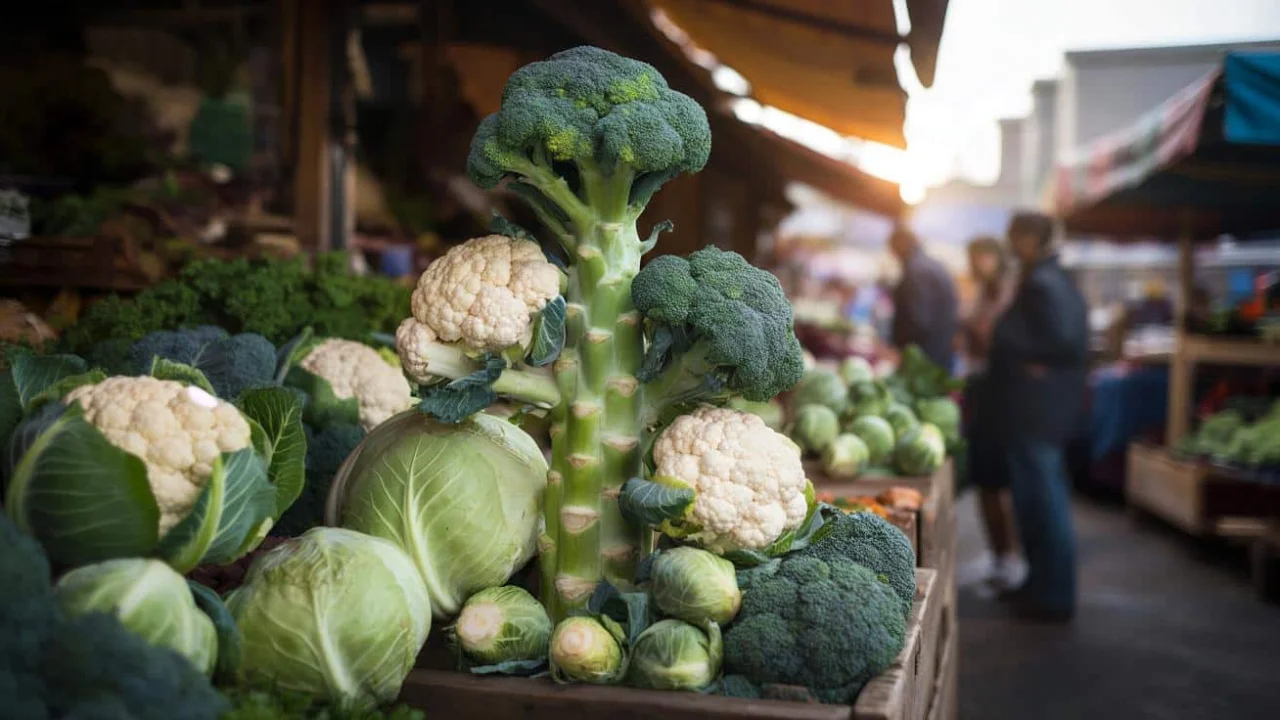
Last Tuesday at the farmers market, I watched a woman stare at three vegetables like they’d just revealed a family secret. The hand-scrawled sign read “Same species, different shapes” with arrows pointing to cauliflower, broccoli, and cabbage. She picked up each one, turning them over in her hands.

“You’re telling me these are basically the same plant?” she asked the vendor, her voice carrying that mix of disbelief and curiosity we all get when reality shifts slightly.
The farmer nodded, slicing off a piece of raw cauliflower for her to taste. “Same DNA, different stories,” he said simply. Around us, other shoppers slowed down, suddenly seeing their weekly grocery run in a completely new light.
The botanical family reunion you never knew about
Here’s the mind-bending truth: cauliflower, broccoli, cabbage, kale, Brussels sprouts, and kohlrabi are all brassica oleracea varieties. Not distant cousins. Not similar species. They’re the same plant, sculpted by centuries of human patience and obsession into wildly different forms.
Think about that for a second. The tight white florets of cauliflower, the tree-like crown of broccoli, and the layered leaves of cabbage all started from the same scraggly coastal plant that once clung to Mediterranean cliffs.

“It’s like looking at a family photo where one sibling became a bodybuilder, another became a ballerina, and the third decided to become a porcupine,” explains Dr. Maria Santos, a plant geneticist at Cornell University. “Same parents, completely different life choices.”
The original wild brassica oleracea still exists today. It’s a modest, bitter plant that most people would walk past without a second glance. But ancient farmers saw potential where others saw weeds.

How humans turned one plant into a vegetable empire
The transformation didn’t happen overnight. It took thousands of years of selective breeding, with farmers patiently choosing plants that showed interesting mutations or traits. Here’s how each variety developed its signature look:
| Vegetable | What Was Selected | Time Period | Original Region |
|---|---|---|---|
| Cabbage | Enlarged terminal bud | 600 BCE | Northern Europe |
| Kale | Large, loose leaves | 2000 BCE | Mediterranean |
| Broccoli | Immature flower heads | 500 CE | Italy |
| Cauliflower | Undeveloped flower clusters | 1200 CE | Cyprus |
| Brussels Sprouts | Axillary buds along stem | 1200 CE | Belgium |
| Kohlrabi | Swollen stem base | 1400 CE | Northern Europe |
Each group of farmers became obsessed with different plant parts. Mediterranean growers fell in love with leaves, creating kale. Northern Europeans got excited about compact growth, leading to cabbage. Italian farmers couldn’t stop staring at flower buds, giving us broccoli and cauliflower.

“It’s basically the same story told six different ways,” notes botanical historian Dr. James Richardson. “Humans saw something interesting and said, ‘Let’s make more of that.'”
The process was surprisingly simple but required incredible patience. Farmers would:
- Save seeds only from plants showing desired traits
- Plant those seeds the following season
- Select again from the offspring showing the strongest characteristics
- Repeat this process for decades or centuries
Why this matters for your dinner plate
Understanding that these brassica oleracea varieties share the same genetic foundation explains a lot about your cooking experiences. Ever notice how cabbage, broccoli, and cauliflower all get that distinctive sulfur smell when overcooked? That’s their shared chemistry showing through.
The nutritional benefits are remarkably similar too. All varieties pack vitamin C, fiber, and compounds called glucosinolates that give them their slightly bitter edge and potential health benefits.
“When people tell me they hate Brussels sprouts but love cabbage, I tell them they basically hate and love the same plant,” says chef and food educator Lisa Chen. “It’s all about preparation and which part of the plant’s personality you’re highlighting.”
This knowledge can transform how you approach cooking these vegetables. Since they’re essentially siblings, techniques that work well for one often work for others:
- Quick, high-heat cooking preserves sweetness in all varieties
- Salt draws out moisture and concentrates flavors across the family
- Acid (lemon juice, vinegar) brightens the natural earthiness
- Fat helps balance the slight bitterness common to all brassicas
The environmental impact is worth considering too. These plants are remarkably adaptable because they’re essentially the same species with different costumes. They can often grow in similar conditions, making crop rotation and sustainable farming easier than managing completely different plant families.
Modern plant breeders continue the ancient tradition, developing new varieties like purple cauliflower, broccolini, and rainbow chard. “We’re still writing new chapters in the same story that started thousands of years ago,” explains agricultural researcher Dr. Patricia Huang.
Next time you’re pushing Brussels sprouts around your plate or marveling at a perfect head of broccoli, remember you’re looking at the result of humanity’s longest-running science experiment. We took one humble coastal plant and turned it into a diverse family that feeds millions of people worldwide.
It makes you wonder what other ordinary things around us might be hiding extraordinary stories.
FAQs
Can different brassica oleracea varieties cross-pollinate with each other?
Yes, they can interbreed because they’re the same species. This is how plant breeders create new varieties like broccolini.
Why do some people taste brassica vegetables as more bitter than others?
Genetic differences in taste receptors make some people more sensitive to glucosinolates, the compounds that create bitterness in all brassica varieties.
Are there other plants that have been diversified like brassica oleracea?
Yes, corn varieties all come from teosinte, and many citrus fruits derive from just a few original species through centuries of selective breeding.
Do wild brassica oleracea plants still exist?
Yes, you can still find the original wild form growing on coastal cliffs in the Mediterranean, Atlantic coasts of France, Spain, and Britain.
Which brassica variety was developed first?
Kale is considered the oldest, most closely resembling the original wild plant with its loose, large leaves.
Can you grow different brassica varieties together in a garden?
You can, but keep them separated if you want to save pure seeds, as they’ll cross-pollinate and create hybrid offspring.
About the Author
