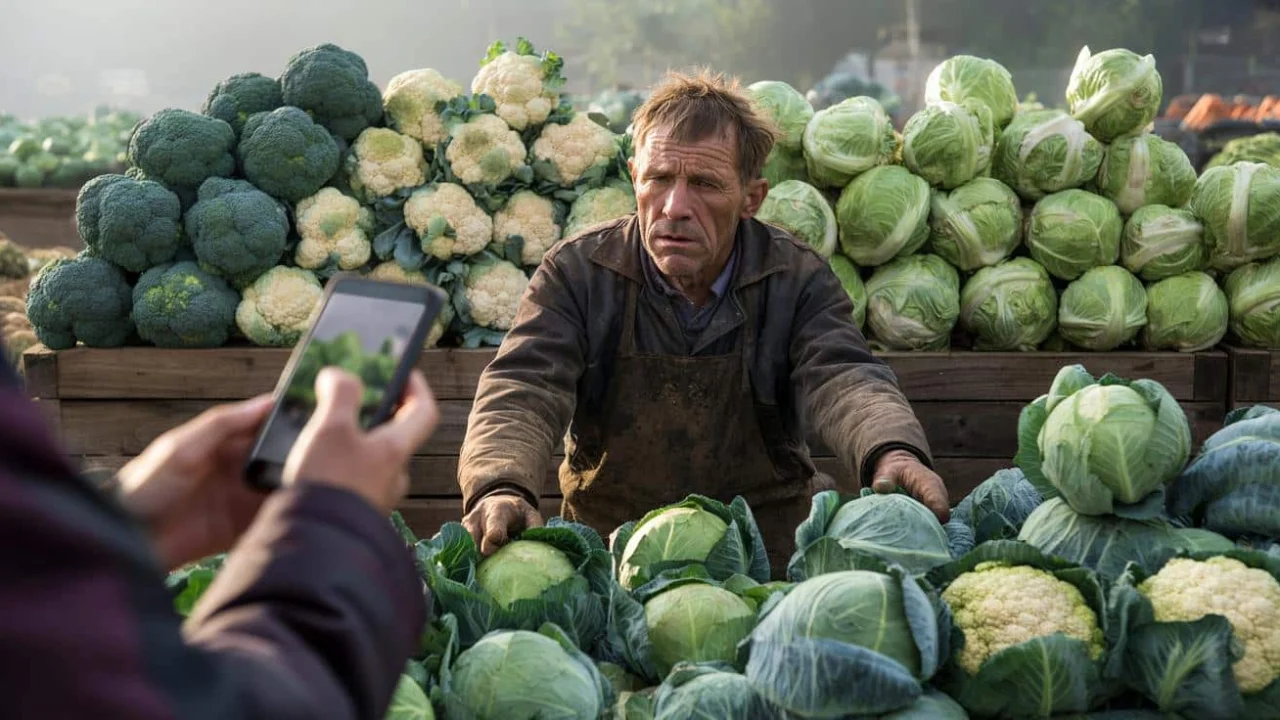
Maria walked into the grocery store last Tuesday, determined to eat healthier. She grabbed broccoli for Monday, cauliflower for Wednesday, and cabbage for Friday’s stir-fry. “Look at all this variety,” she thought, feeling proud of her colorful cart.

What she didn’t know would have blown her mind: she’d just picked up the same plant three times.
That exhausted farmer at the weekend market wasn’t lying when he told confused customers that his broccoli, cauliflower, and cabbage were “basically identical.” He was sharing one of agriculture’s best-kept secrets, and frankly, he’s getting tired of the shocked reactions.

The Mind-Bending Truth About Brassica Oleracea Vegetables
Here’s what’s happening in farms across the world: those “different” vegetables crowding your dinner plate are actually the same species wearing different costumes. Broccoli, cauliflower, cabbage, kale, Brussels sprouts, and kohlrabi all share the scientific name Brassica oleracea.
Think of it like this: imagine you could take one wild plant and sculpt it into completely different shapes. That’s exactly what farmers have been doing for thousands of years, without even realizing they were performing genetic artistry.

“When I explain to customers that my broccoli and cabbage fields are growing the same plant, they look at me like I’m crazy,” says Tom Henderson, a third-generation vegetable farmer from Vermont. “But it’s the truth. We’ve just been selecting different parts of the same plant to grow bigger.”
The wild ancestor of all these vegetables still grows along Mediterranean coastlines. It’s a scraggly, unremarkable plant that early farmers began tinkering with around 2,500 years ago. Some selected plants with bigger leaves, others chose plants with fatter flower buds, and others focused on thicker stems.

Over centuries, this selective breeding created what scientists call “cultivars” – basically the same plant trained to emphasize different body parts.
Breaking Down the Brassica Family Tree
Here’s where things get really wild. Each “vegetable” you know is actually just one part of the original plant, bred to extremes:

| Vegetable | What Part It Actually Is | What Farmers Selected For |
|---|---|---|
| Broccoli | Flower buds | Large, tight flower clusters |
| Cauliflower | Flower buds | Dense, white, underdeveloped flowers |
| Cabbage | Leaves | Tightly packed leaf heads |
| Kale | Leaves | Large, loose, curly leaves |
| Brussels Sprouts | Buds | Mini cabbage-like buds on stems |
| Kohlrabi | Stem | Swollen, bulbous stem base |
Recent genetic studies have confirmed what farmers suspected all along. Dr. Sarah Chen, a plant geneticist at UC Davis, explains: “When we map the DNA of these plants, the differences are incredibly minor. We’re talking about just a few genes that control growth patterns.”
The implications are staggering. That “rainbow of vegetables” you’ve been told to eat for optimal nutrition? You might actually be eating the same plant over and over again, just prepared differently.
- Broccoli and cauliflower are both immature flower clusters
- The main difference is that cauliflower lacks chlorophyll in its flowers
- Cabbage heads can weigh up to 20 pounds, but they’re just tightly wound leaves
- Brussels sprouts grow as tiny cabbages along a single tall stem
- Kale is simply the loose-leaf version of cabbage
Why Farmers Are Fed Up With the Confusion
The frustration among growers is real and growing. Many farmers spend significant time educating customers about what they’re actually buying, often facing skepticism or outright disbelief.
“I have people argue with me about my own crops,” says Jennifer Walsh, who runs a 200-acre farm in Oregon. “They insist that broccoli and cauliflower are completely different plants because they look different. It’s like explaining that chihuahuas and great danes are the same species.”
The confusion affects business in unexpected ways:
- Customers demand different prices for the “same plant”
- Marketing becomes complicated when trying to promote diversity
- Crop rotation planning gets misunderstood by new farmers
- Pest management strategies overlap because insects don’t distinguish between cultivars
From a farming perspective, treating these as separate plants creates logistical nightmares. The same pests attack all brassica oleracea vegetables. The same diseases spread between them. They require similar soil conditions and growing seasons.
“When a customer complains that my cauliflower got aphids ‘just like the broccoli,’ I want to scream ‘of course it did!'” explains Mark Rivera, who’s been growing brassicas for 15 years. “They’re the same plant with the same vulnerabilities.”
The revelation is spreading through social media, creating both awareness and backlash. Food influencers share mind-blowing facts about vegetable origins, while traditional grocery marketing struggles to adapt to informed consumers who now understand they’re buying variations of single species.
Some farmers are embracing the education opportunity, using it as a conversation starter about agricultural history and plant breeding. Others worry it might devalue their diverse-looking produce in the eyes of nutrition-conscious shoppers.
The bigger picture reveals how much we’ve shaped our food through centuries of selection, often without fully understanding what we were doing. These brassica oleracea vegetables represent one of humanity’s greatest unintentional genetic experiments – and we’ve been eating the results our entire lives.
FAQs
Are broccoli, cauliflower, and cabbage really the same plant?
Yes, they’re all cultivars of Brassica oleracea, meaning they’re the same species bred to emphasize different plant parts over thousands of years.
Do these vegetables have the same nutritional value since they’re the same plant?
While they share the same genetic base, their nutritional profiles differ because they develop different plant parts – leaves, flowers, or stems – which contain varying nutrient concentrations.
How did farmers create such different-looking vegetables from one plant?
Through selective breeding over millennia, farmers chose plants with desirable traits like bigger leaves or denser flower buds, gradually creating distinct varieties.
What other vegetables are actually the same plant?
Besides the ones mentioned, collard greens and Chinese broccoli are also Brassica oleracea varieties, bringing the total to at least eight common vegetables from one species.
Why don’t grocery stores explain this to customers?
Most retailers focus on marketing vegetables as diverse options for health benefits rather than educating about their botanical relationships, which could confuse rather than help sales.
Does this mean I’m not getting dietary diversity if I eat multiple brassicas?
You’re still getting nutritional variety because different plant parts (leaves vs. flowers vs. stems) provide different vitamins, minerals, and compounds, even from the same species.
About the Author