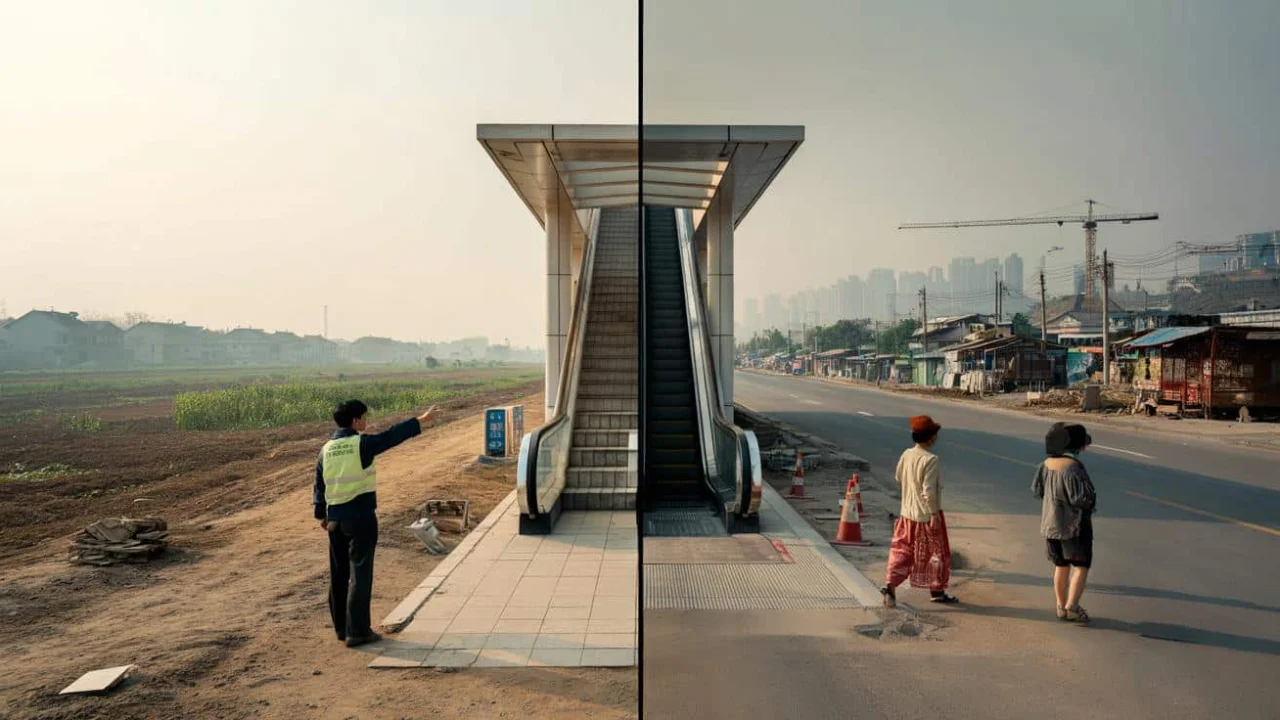
I remember standing on a gleaming metro platform in 2008, surrounded by nothing but empty fields and construction dust. The escalator hummed beneath my feet, the air conditioning worked perfectly, and a digital display announced the next train in three languages. But when I walked outside, there wasn’t a single building taller than two stories for miles.

“This is insane,” I muttered to my colleague, snapping a photo of the lonely station entrance. “Who’s going to use this?” Around us, a handful of construction workers bought bottled water from a small kiosk, the only sign of human activity in what felt like the middle of nowhere.
That moment perfectly captured what many of us thought about China’s metro expansion in the late 2000s. We saw empty stations, half-filled trains, and infrastructure that seemed years ahead of demand. We called them “ghost stations” and shook our heads at what looked like spectacular overbuilding. Fifteen years later, those same stations are packed with commuters, surrounded by gleaming towers and bustling neighborhoods. We weren’t witnessing waste—we were watching the future being built before our eyes.

When “Build It and They Will Come” Actually Worked
China metro stations in 2008 looked like someone had dropped pieces of Tokyo into rural farmland. These weren’t small, basic stops either. We’re talking about full-scale transit hubs with multiple exits, shopping areas, and connections to bus networks that didn’t exist yet.
Beijing’s Line 4 opened in 2009 with stations like Tiangongyuan that served maybe a few hundred passengers daily. The platforms were so quiet you could hear your footsteps echo. International media covered these “empty” stations as examples of China’s infrastructure obsession, missing the bigger picture entirely.

“Western observers kept asking about immediate ridership numbers,” explains Dr. Sarah Chen, an urban planning researcher who studied China’s metro expansion. “But Chinese planners were thinking in decades, not quarters.”
Shanghai’s Pudong district tells the same story. In 2005, metro stations there felt like elaborate movie sets waiting for actors. Today, those same stations handle millions of passengers annually, serving one of the world’s busiest financial districts.

The strategy wasn’t random. Chinese urban planners used metro lines as development anchors, knowing that reliable transit would attract businesses, residents, and investment. They built the infrastructure first, then let economic gravity do the rest.
The Numbers That Tell the Real Story
Looking back at China’s metro expansion reveals just how dramatically we underestimated their planning vision. The scale and speed of growth that followed those “empty” stations is staggering:

| Year | Total Metro Lines | Cities with Metro Systems | Daily Passengers (Millions) |
|---|---|---|---|
| 2008 | 65 | 10 | 12 |
| 2015 | 142 | 22 | 45 |
| 2023 | 298 | 48 | 87 |
But the transformation around individual stations tells an even more dramatic story. Consider these changes at formerly “empty” locations:
- Beijing’s Tiangongyuan: From 800 daily passengers (2009) to 85,000 daily passengers (2023)
- Shanghai’s Century Avenue: Surrounded by construction sites in 2005, now serves 120,000 passengers daily
- Guangzhou’s Zhujiang New Town: Built in agricultural land, now the heart of a major business district
- Shenzhen’s Civic Center: Opened to empty lots, now connects three major shopping malls and office complexes
“The patience required for this kind of planning is remarkable,” notes infrastructure analyst Michael Rodriguez. “Most democratic systems can’t commit to 20-year development timelines like this.”
What looked like overbuilding was actually precise economic engineering. China metro stations weren’t just transportation hubs—they were catalysts for entire neighborhoods.
What This Taught Us About Long-Term Thinking
The success of China’s “premature” metro stations fundamentally changed how urban planners worldwide think about infrastructure investment. Cities from India to Brazil now study China’s model of building transit before demand materializes.
The economic impact extends far beyond just moving people around. Property values near China metro stations increased by an average of 15-25% within five years of opening. Businesses followed the infrastructure, creating employment hubs that justified the original investment many times over.
“We were measuring success wrong,” admits former transit consultant James Parker. “We looked at day-one ridership instead of decade-ten neighborhood transformation.”
This approach required enormous upfront capital and political commitment to long-term goals over short-term profits. Chinese planners could absorb years of low utilization because they were building for 2030, not 2010.
The model also depended on rapid urbanization and economic growth that might not translate to other countries. China had millions of rural residents ready to move to cities, plus booming industries that could fill the spaces around new stations.
Today, those formerly empty China metro stations serve as case studies in forward-thinking urban development. What seemed like ghostly infrastructure turned out to be the foundation for some of Asia’s most vibrant urban districts.
The lesson wasn’t just about transportation planning—it was about having the vision to build for tomorrow rather than just solving today’s problems. Sometimes what looks like overbuilding is actually just building ahead of the curve.
FAQs
Why did China build metro stations in empty areas?
Chinese planners used metro stations as development anchors, knowing that reliable transit would attract businesses and residents to create new urban districts.
How long did it take for these “empty” stations to fill up?
Most stations saw significant increases in ridership within 5-7 years, with full neighborhood development typically taking 10-15 years.
Did this strategy work in all Chinese cities?
The strategy was most successful in major cities with rapid economic growth, though some smaller cities still have underutilized stations.
Can other countries replicate China’s metro expansion model?
The model requires significant upfront investment, political commitment to long-term planning, and rapid urban population growth that may not exist elsewhere.
What was the total cost of China’s metro expansion?
China has invested over $300 billion in metro construction since 2000, with individual lines costing $100-500 million per kilometer.
How accurate were early predictions about ridership?
Most international observers significantly underestimated future ridership, focusing on immediate usage rather than long-term urban development potential.
About the Author