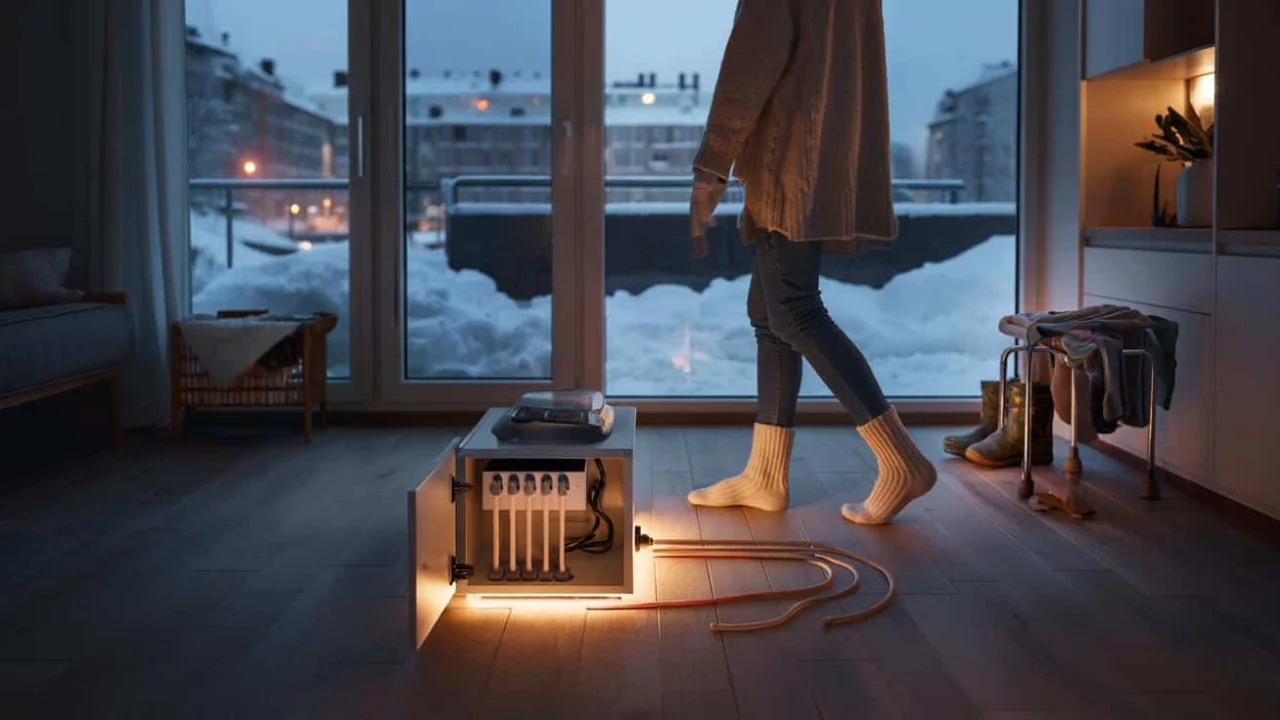
Last winter, I was house-sitting for a colleague in Helsinki when the temperature dropped to -25°C. As an American used to cranking up the thermostat and huddling near heating vents, I panicked when I couldn’t find a single radiator in the entire apartment. No baseboard heaters, no wall units, nothing. Yet somehow, walking around in just my socks felt perfectly comfortable.
The mystery solved itself when I noticed the bathroom tiles were pleasantly warm under my feet. Then the kitchen floor. Then everywhere I stepped. My friend had casually mentioned “lattialämmitys” before leaving – a word I’d dismissed as typical Finnish complexity. Turns out, it translates to something beautifully simple: floor heating.
What I discovered that week changed how I think about home heating entirely. The Finns have been quietly perfecting a heating method that uses the most basic resource most of us already have: hot water.

How Finland ditched radiators for something hiding under your feet
Finland faces some of the harshest winters on Earth, with temperatures regularly plummeting below -30°C. You’d expect Finnish homes to be packed with massive heating systems, but walk into a modern Finnish house and you’ll be struck by what’s missing: radiators.
Instead, underfloor heating has become the standard in new construction and renovations. The system works exactly like your existing hot water setup, except the heated water flows through pipes embedded beneath your floors instead of feeding wall-mounted radiators.

“The beauty of underfloor heating is its invisibility,” explains Mika Virtanen, a Helsinki-based heating engineer. “You get consistent warmth without losing wall space, without dust circulation, and without the temperature fluctuations that make traditional radiators so inefficient.”
The principle is elegantly simple. Warm water circulates through flexible pipes laid in a serpentine pattern under your flooring. This turns your entire floor into a gentle, even heat source that warms objects and people directly rather than just heating air.

| Traditional Radiators | Underfloor Heating |
|---|---|
| Heat air, creating hot spots and cold zones | Heat objects and people evenly |
| Require wall space | Completely invisible |
| Create air circulation and dust movement | No air movement, less dust circulation |
| Quick to heat up and cool down | Slow, steady temperature control |
| Water temperature: 70-80°C | Water temperature: 35-40°C |
Why this everyday heating revolution makes perfect sense
The shift to underfloor heating in Finland isn’t just about comfort – it’s about energy efficiency and practicality. Because the system operates at much lower water temperatures than traditional radiators, it works perfectly with modern condensing boilers and heat pumps.
“We’re seeing 15-20% energy savings compared to radiator systems,” notes Anna Korhonen, a sustainable building consultant in Tampere. “The floor acts like thermal mass, storing and releasing heat gradually, which means fewer temperature swings and less energy waste.”

Here’s what makes underfloor heating particularly clever:
- Lower operating temperatures: While radiators need water heated to 70-80°C, underfloor systems work efficiently with water at just 35-40°C
- Radiant heat: Warms people and objects directly, not just air, making rooms feel comfortable at lower air temperatures
- No maintenance: Once installed, the system is virtually maintenance-free for decades
- Silent operation: No clicking, hissing, or gurgling sounds
- Better air quality: No dust circulation from convection currents
- Design freedom: No radiators means more usable wall space
The installation process is surprisingly straightforward. For new construction, installers lay insulation boards on the floor, then place plastic piping in loops across the surface before pouring a thin concrete screed on top. For existing homes, low-profile systems can be installed with minimal floor height increase.
“The biggest surprise for most people is realizing they already have 80% of what they need,” explains heating contractor Jari Lehtinen. “Your existing boiler, your hot water system – it all works. We’re just redirecting that warm water to flow under your feet instead of through radiators on your walls.”
The global heating shift Finland is quietly leading
While Finland has embraced underfloor heating as standard practice, other countries are catching on. In Germany, over 50% of new homes now include radiant floor systems. South Korea has used similar “ondol” heating for centuries. Even in milder climates, homeowners are discovering the comfort and efficiency benefits.
The technology works in virtually any climate where heating is needed. In moderate regions, it can eliminate the need for air conditioning by keeping homes naturally cool in summer – the same thermal mass that stores heat in winter helps maintain comfortable temperatures year-round.
“I installed underfloor heating in my California home after experiencing it in Finland,” shares American architect Sarah Chen. “Even in our mild winters, the consistent comfort and energy savings made it worthwhile. My heating bills dropped by about 25%.”
The cost factor often surprises homeowners too. While installation requires upfront investment, the long-term savings typically offset initial costs within 7-10 years. The system’s 30+ year lifespan means decades of reduced energy bills afterward.
For existing homes, retrofit options are becoming more accessible. Thin systems can be installed over existing floors with minimal disruption, and some new technologies allow installation without removing existing flooring entirely.
Modern underfloor heating systems also integrate seamlessly with smart home technology. Zone controls let you heat different areas independently, and programmable thermostats learn your schedule to optimize energy usage automatically.
Perhaps most importantly, underfloor heating addresses the growing demand for sustainable heating solutions. As countries phase out fossil fuel heating and embrace heat pumps and renewable energy, the low operating temperatures required for radiant floor systems make them ideal partners for these emerging technologies.
The Finnish approach to heating represents more than just technological advancement – it’s a fundamental rethink of how we create comfortable living spaces. By turning the floor itself into a heating element, they’ve created systems that are more efficient, more comfortable, and virtually invisible.
That warm floor that surprised me in Helsinki wasn’t just heated tiles – it was a glimpse into the future of home heating, powered by the same everyday hot water system that’s probably already running through your walls right now.
FAQs
Can underfloor heating work with my existing hot water boiler?
Yes, most existing boilers can power underfloor heating systems, often more efficiently than radiators since the water doesn’t need to be heated as high.
Is underfloor heating expensive to install?
Installation costs vary, but most homeowners see energy savings of 15-25% that offset the initial investment within 7-10 years.
How long does underfloor heating take to warm up a room?
Unlike radiators, underfloor systems heat up slowly over 2-3 hours but maintain very consistent temperatures once running.
Can I install underfloor heating in an existing home?
Yes, low-profile systems can be retrofitted over existing floors, typically raising floor height by just 15-25mm.
Does underfloor heating work with all types of flooring?
Most flooring works well, including tile, stone, engineered wood, and laminate. Thick carpets can reduce efficiency but special underlay can help.
Is underfloor heating reliable long-term?
Modern systems are extremely reliable, typically lasting 30+ years with minimal maintenance since there are no moving parts to break down.
About the Author
