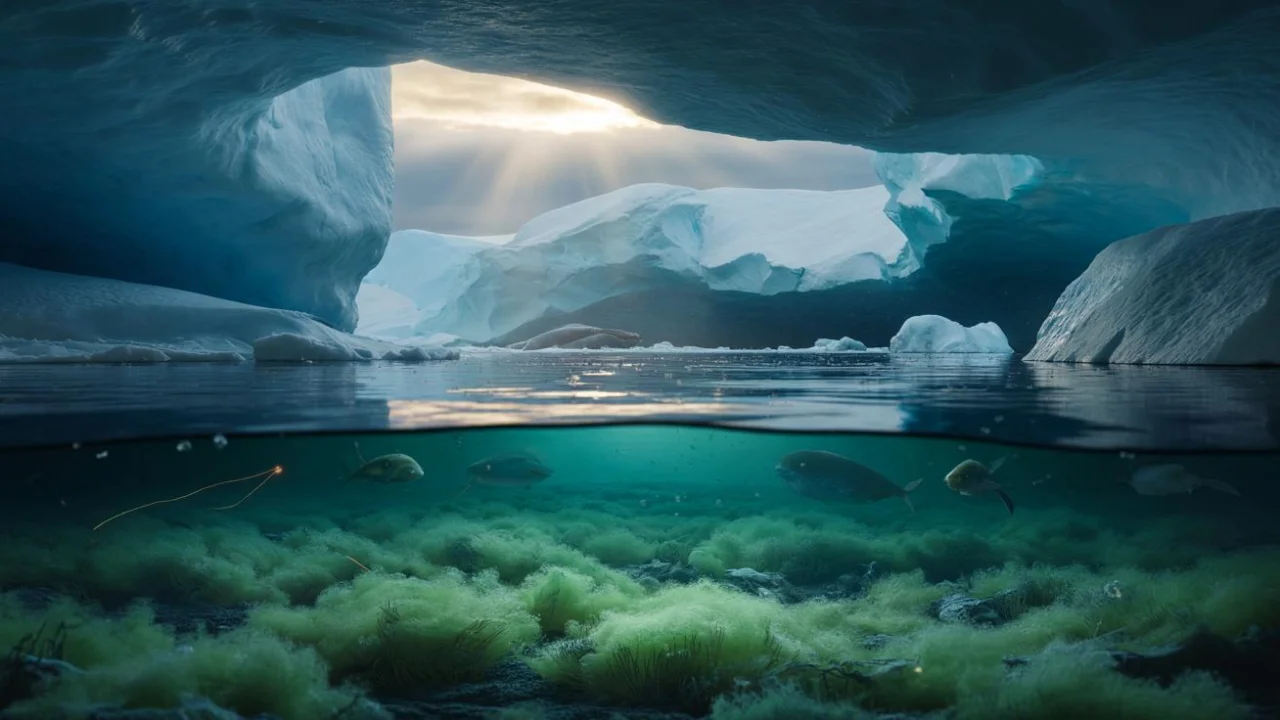
Picture this: You’re standing on what looks like an endless frozen wasteland, the Arctic Ocean stretching to every horizon under thick ice. The silence is absolute. Nothing moves. Nothing grows. Or so we thought.

Dr. Sarah Chen felt that same eerie stillness during her first research expedition to the Eurasian Basin three years ago. “I remember thinking this place looked completely dead,” she recalls. “Just white ice as far as you could see, and black water underneath.” But when she lowered her sampling equipment through a hole in the ice, what came back up changed everything we know about one of Earth’s most mysterious ecosystems.
Beneath that deceptive calm, Chen and her team discovered something extraordinary: arctic microbes nitrogen-fixing at rates that could reshape our understanding of global climate patterns. These tiny organisms are quietly working as nature’s own fertilizer factories, and they might just be our planet’s secret weapon against climate change.

The Arctic’s Hidden Biological Revolution
For generations, scientists treated the Arctic Ocean like Earth’s biological desert. Textbooks described it as a frozen wasteland where life barely survived the dark, bitter winters. That narrative is crumbling fast.
What researchers are finding instead is a complex, bustling ecosystem powered by arctic microbes nitrogen production. These microscopic organisms, called diazotrophs, are pulling nitrogen gas directly from the atmosphere and converting it into ammonia – essentially creating their own fertilizer in some of the planet’s most hostile conditions.

“We’re not talking about a few scattered microbes hanging on for dear life,” explains marine biologist Dr. Lisa von Friesen, who led groundbreaking research aboard the German vessel Polarstern. “These are thriving communities doing serious biochemical work under multi-year ice that we thought was basically lifeless.”
The discovery is forcing climate scientists to completely rethink how Arctic ecosystems function. As summer sea ice continues shrinking, more sunlight penetrates deeper into the ocean. River runoff and melting ice bring fresh nutrients. In this changing environment, nitrogen-fixing microbes are exploding in numbers.

But here’s the twist that has everyone excited: many of these arctic microbes aren’t the typical cyanobacteria you’d find in tropical waters. Instead, they’re specialized “non-cyanobacterial” bacteria that have adapted to work in near-freezing temperatures that would kill their warm-water cousins.
How Tiny Microbes Pack a Climate Punch
Understanding why arctic microbes nitrogen fixation matters requires grasping a simple but powerful chain reaction that starts in the microscopic world and ends up affecting global weather patterns.

Nitrogen is like vitamin B for ocean life – absolutely essential but often in short supply. Most marine plants and algae can’t access the nitrogen gas that makes up 78% of our atmosphere. They need it converted into ammonia or nitrates first.
Here’s where these Arctic heroes step in:
- Step 1: Nitrogen-fixing bacteria pull nitrogen gas from seawater
- Step 2: They convert it into ammonia using specialized enzymes
- Step 3: This “fixed” nitrogen feeds massive algae blooms
- Step 4: Growing algae suck carbon dioxide from the atmosphere
- Step 5: Some carbon gets locked away in deep ocean sediments
“Think of it as a biological carbon capture machine,” says Dr. Chen. “The more nitrogen these microbes fix, the more algae can grow, and the more CO2 gets pulled out of our atmosphere.”
Recent measurements published in Communications Earth & Environment reveal just how significant this process has become. Researchers detected nitrogen fixation rates of up to 5.3 nanomoles per liter per day across vast stretches of Arctic water – from melting ice margins all the way to the remote Wandel Sea.
| Arctic Region | Nitrogen Fixation Rate | Estimated Carbon Impact |
|---|---|---|
| Eurasian Basin | 3.2 nmol/L/day | High carbon sequestration |
| Wandel Sea | 5.3 nmol/L/day | Extremely high potential |
| Greenland margins | 4.1 nmol/L/day | Moderate to high impact |
| Barents Sea edge | 2.8 nmol/L/day | Growing significance |
What This Means for Our Climate Future
The implications of widespread arctic microbes nitrogen activity stretch far beyond academic curiosity. We’re talking about a natural climate solution that’s been working under our noses – or rather, under our ice – this whole time.
Climate models used by governments and international organizations to plan carbon reduction strategies have largely ignored Arctic nitrogen fixation. Most assumed these icy waters contributed little to global carbon cycling. Those models now need major updates.
“We’ve been underestimating the Arctic Ocean’s role as a carbon sink,” admits Dr. Michael Torres, a climate modeler at the International Arctic Research Center. “If these microbes are fixing nitrogen at the rates we’re seeing, and if that trend continues as ice melts, the Arctic could become a much more powerful ally against climate change than we realized.”
But there’s a catch. This biological boost depends on conditions staying just right. Too much warming could disrupt the delicate balance these arctic microbes nitrogen systems have achieved. Too much freshwater from melting ice could change ocean chemistry in ways that shut down the process.
The race is now on to understand exactly how much these invisible workers can help, and how we might protect or even enhance their climate-fighting abilities. Some researchers are exploring whether strategic nutrient additions could supercharge natural nitrogen fixation in Arctic waters.
Others worry about unintended consequences. “Nature took millions of years to develop these systems,” warns Dr. von Friesen. “We need to understand them completely before we start tinkering.”
For now, the discovery offers something rare in climate science: genuine hope backed by hard data. As politicians and activists debate carbon taxes and renewable energy targets, microscopic arctic microbes nitrogen production continues quietly pulling greenhouse gases from our atmosphere, one molecule at a time.
The next time you see footage of melting Arctic ice, remember: underneath that white expanse, an army of invisible allies is working around the clock to help stabilize our planet’s climate. We’re just finally learning to see them.
FAQs
What exactly are nitrogen-fixing microbes?
These are bacteria that can capture nitrogen gas from the atmosphere and convert it into ammonia, which other marine life can use as fertilizer for growth.
Why does nitrogen fixation help fight climate change?
The fixed nitrogen feeds algae blooms that absorb carbon dioxide from the atmosphere, effectively removing greenhouse gases from the air.
How long have these Arctic microbes been active?
They’ve likely existed for millennia, but scientists only recently developed tools sensitive enough to detect their activity under ice in extreme cold conditions.
Could this process slow down global warming significantly?
While promising, researchers are still calculating the full impact. Early estimates suggest it could be substantial, but more study is needed.
What happens to these microbes if Arctic ice completely melts?
That’s a key concern. The microbes might thrive with more sunlight, or changing conditions could disrupt their delicate ecosystem entirely.
Can we artificially enhance this natural process?
Some scientists are exploring this possibility, but most urge caution since we don’t fully understand the complex Arctic ecosystem yet.
About the Author