Ahmed Hassan remembers his grandfather’s stories about the Silk Road. How merchants would gather in caravans, load their camels with precious goods, and then take the longest possible routes to avoid one terrifying stretch of desert. “My grandfather called it the place where the earth drinks men,” Hassan says, sipping tea in his small restaurant in Urumqi. “He said even the bravest traders would add weeks to their journey rather than cross it.”

That desert was the Taklamakan, a name that still sends shivers down the spines of locals who grew up hearing tales of travelers swallowed by shifting sands. For over two thousand years, this wasteland represented everything humans feared about nature’s power.
Yet today, Hassan’s nephew works at a fish farm right in the heart of that same “ocean of death.” He tends to tanks full of salmon and bass where his ancestors believed nothing could survive.

When the impossible becomes profitable
The Taklamakan Desert in China’s Xinjiang region spans over 130,000 square miles of some of the harshest terrain on Earth. Its Uyghur name translates roughly to “go in and you won’t come out,” and for millennia, that warning proved accurate. Temperatures swing from scorching summer highs to bone-chilling winter lows, while sandstorms can bury entire settlements overnight.
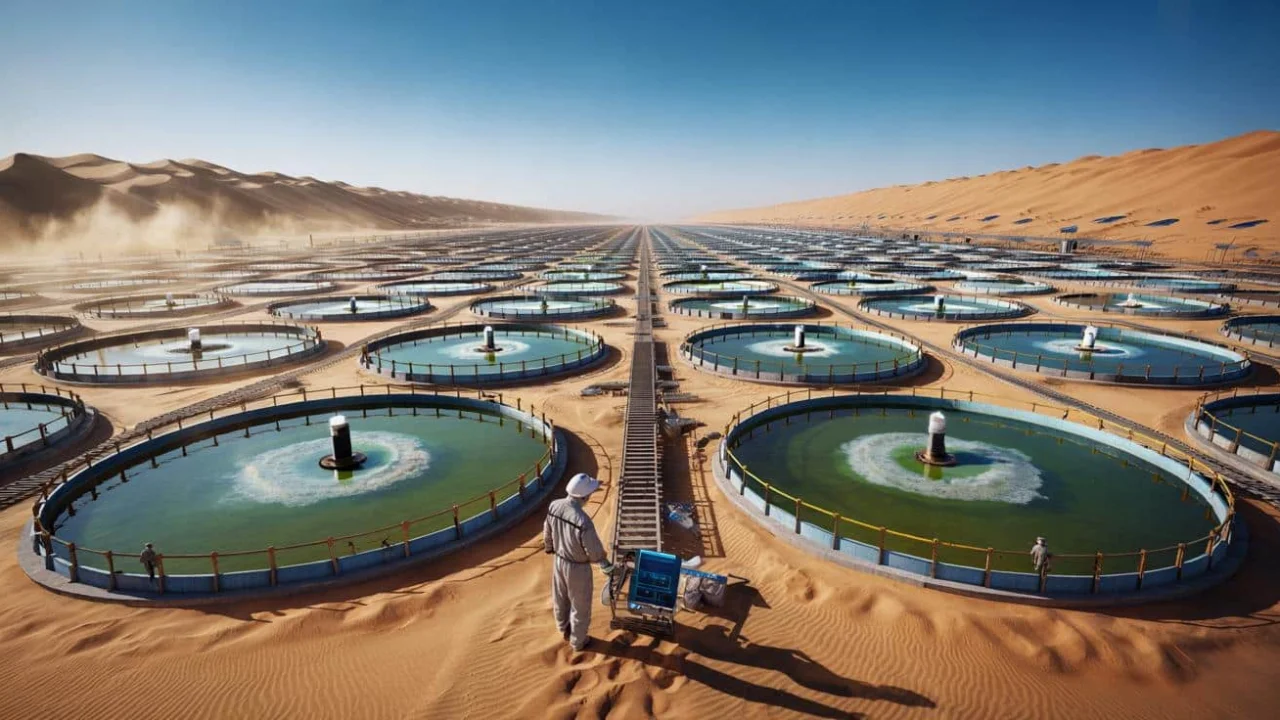
But something remarkable is happening in this forbidden landscape. Chinese engineers have built industrial fish farms that are not just surviving in the desert – they’re thriving.

“We’re not fighting the desert anymore,” explains Dr. Liu Wei, an aquaculture specialist who has worked on Taklamakan desert fishing projects for five years. “We’re learning to work with it, using what nature gives us instead of importing everything from thousands of miles away.”
The transformation seems almost magical. Where ancient maps once warned “here be dragons,” satellite images now show geometric patterns of fish ponds stretching across the sand. The hum of aerators and water pumps has replaced the howling wind as the dominant sound near these desert oases.

Chinese authorities see these Taklamakan fishing operations as more than just an engineering marvel. They represent a strategic shift toward food security independence and a solution to overfished coastal waters.
The science of turning sand into seafood
Creating successful Taklamakan desert fishing operations requires solving problems that would make most engineers quit before they started. The biggest challenge isn’t the lack of water – it’s the wrong kind of water.

The desert’s groundwater contains heavy concentrations of salt and alkali that would kill most freshwater fish instantly and corrode traditional farming equipment within months. Instead of viewing this as an obstacle, engineers discovered they could transform this liability into an asset.
Here’s how the process works:
- Groundwater extraction: Deep wells tap into saline aquifers beneath the desert
- Chemical treatment: Filtration systems adjust salinity and pH to mimic seawater conditions
- Recirculating systems: Closed-loop tanks minimize water waste while maintaining perfect growing conditions
- Climate control: Insulated buildings protect fish from desert temperature extremes
- Automated monitoring: Sensors track oxygen, temperature, and nutrient levels around the clock
| Challenge | Traditional Solution | Desert Innovation |
|---|---|---|
| Water scarcity | Import freshwater | Use treated saline groundwater |
| Extreme temperatures | Open pond farming | Climate-controlled facilities |
| High salinity | Freshwater dilution | Convert to artificial seawater |
| Remote location | Coastal proximity | Automated systems |
“The beauty of this system is that we’re essentially creating artificial oceans in the middle of nowhere,” says Chen Ming, a marine biologist who helped design the water treatment protocols. “The fish don’t know they’re swimming in the desert.”
The most successful Taklamakan desert fishing facilities focus on saltwater species like salmon, sea bass, and prawns that can thrive in the engineered seawater conditions. Some operations report yields comparable to traditional coastal farms, with the added benefit of complete environmental control.
Ripple effects beyond the sand dunes
The implications of successful Taklamakan desert fishing extend far beyond solving China’s seafood supply challenges. This technology could reshape how we think about food production in some of the world’s most inhospitable places.
For local communities in Xinjiang, these fish farms represent rare economic opportunities in a region where traditional agriculture struggles. Job creation includes everything from facility maintenance to fish processing, providing steady employment in areas previously dependent on subsistence farming or mining.
“My village used to be a place young people left as soon as they could,” explains Fatima Aziz, whose daughter now manages water quality at a nearby facility. “Now we have families moving here for work. It’s changed everything about how we see our future.”
Environmental scientists remain divided about the long-term sustainability of Taklamakan desert fishing. Supporters argue that these closed-loop systems use less water than traditional agriculture and don’t depend on increasingly strained coastal ecosystems. Critics worry about the energy requirements for climate control and water treatment in such a harsh environment.
The economic math, however, appears promising. Initial reports suggest that desert-grown seafood can compete with imported products on price while offering superior freshness due to proximity to major Chinese population centers. Transportation costs from the Taklamakan to cities like Beijing are often lower than shipping seafood from coastal farms.
Perhaps most intriguingly, the technology could have applications far beyond China. Desert regions across Central Asia, the Middle East, and North Africa face similar combinations of water scarcity and food security challenges. If Taklamakan desert fishing proves sustainable at scale, it could provide a blueprint for transforming other “dead” landscapes into productive food systems.
The success of these operations also demonstrates how modern technology can completely invert traditional geographical advantages. The same isolation and harsh conditions that once made the Taklamakan a barrier to human activity now serve as assets in a controlled agricultural environment.
As climate change makes traditional farming increasingly difficult in many regions, the lessons learned from raising fish in one of Earth’s most challenging environments could prove invaluable for global food security.
FAQs
How much fish can these desert farms actually produce?
Current operations produce several thousand tons annually, with expansion plans targeting much larger volumes as the technology proves viable at scale.
Is the fish safe to eat?
Yes, the controlled environment actually allows for stricter quality control than many traditional fish farms, with constant monitoring of water quality and fish health.
How much does it cost compared to regular fish farming?
Initial setup costs are higher, but operational costs can be competitive due to automation and the use of local groundwater instead of imported resources.
Could this work in other deserts?
Similar technology could potentially work in deserts with accessible saline groundwater, though each location would require customized solutions.
What happens to the water after the fish are harvested?
The recirculating systems continuously filter and reuse the same water, with minimal waste compared to traditional farming methods.
Are there any environmental concerns?
Scientists are studying the long-term impacts, particularly regarding groundwater use and energy consumption for climate control in such extreme conditions.
About the Author