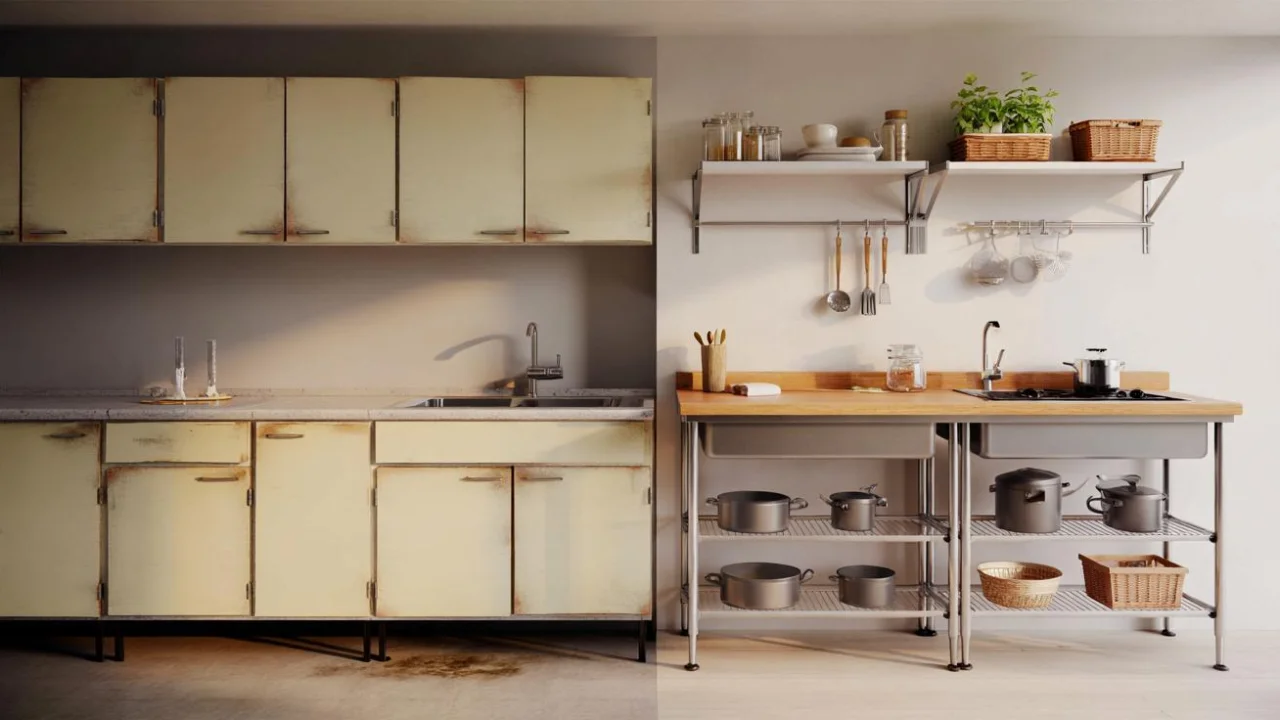
Sarah pulled open her kitchen cupboard and immediately regretted it. That familiar musty smell hit her like a slap – the same smell that had been getting worse for months. The bottom of the cabinet was soft to the touch, the chipboard swollen from a slow leak she’d only just discovered. She’d spent £3,000 on those cabinets just two years ago.

Standing in her ruined kitchen, scrolling through renovation quotes that made her stomach drop, Sarah stumbled across something that changed everything. A video of a couple who’d ditched cabinets entirely, replacing them with sleek metal shelving and industrial-style storage. Their kitchen looked like it belonged in a trendy café, and they’d spent less than £800.
That was six months ago. Now Sarah’s friends can’t stop asking about her “restaurant-style” kitchen that never smells musty, never warps, and somehow cost less than fixing her old cabinets would have.

The hidden costs of traditional kitchen cabinets
Walk through any neighbourhood built in the last 20 years and you’ll find the same story playing out behind closed doors. Kitchen cabinets that looked perfect in the showroom are slowly surrendering to real life. Particleboard swells when it meets moisture. Melamine peels when steam gets underneath. Hinges sag under the weight of heavy dishes.
“Most people don’t realise that standard kitchen cabinets are basically furniture-grade materials trying to do a job they’re not designed for,” explains kitchen designer Marcus Chen, who’s been advocating for open shelving systems for over five years. “You wouldn’t put a bedroom wardrobe next to your shower, but that’s essentially what we’re doing in kitchens.”

The numbers tell the story. Replacing a full set of kitchen cabinets now averages £8,000-£15,000 for a medium-sized kitchen. But here’s the kicker: most of that cost goes toward materials that won’t last in a high-moisture environment. Meanwhile, open shelving alternatives using restaurant-grade materials can transform the same space for £1,500-£3,000.
Open shelving isn’t just about saving money upfront. It’s about choosing materials that actually make sense in a kitchen environment. Stainless steel doesn’t swell. Powder-coated aluminium doesn’t peel. Wire shelving lets air circulate freely, preventing the moisture build-up that kills traditional cabinets.

What open shelving really looks like in practice
Forget everything you think you know about open kitchen storage. This isn’t about exposing your messy cupboards for the world to see. Modern open shelving systems are engineered solutions that work harder and last longer than traditional cabinets.
The key components include:
- Wall-mounted rail systems – Heavy-duty tracks that hold adjustable shelves, hooks, and storage baskets
- Stainless steel or powder-coated shelving – Materials that handle moisture, heat, and daily use without degrading
- Modular base units – Industrial-style cabinets designed for commercial kitchens but sized for homes
- Open framework storage – Metal structures that provide the storage capacity of cabinets without the enclosed, moisture-trapping design
“The beauty of open shelving is that everything is accessible and maintainable,” notes interior designer Claire Thompson, who’s helped dozens of clients make the switch. “When something breaks or wears out, you replace one component, not the entire kitchen.”
| Feature | Traditional Cabinets | Open Shelving Systems |
|---|---|---|
| Average Cost | £8,000-£15,000 | £1,500-£3,000 |
| Moisture Resistance | Poor (particleboard/MDF) | Excellent (metal construction) |
| Replacement Cost | Full kitchen renovation | Individual components |
| Installation Time | 1-2 weeks | 1-3 days |
| Maintenance | Complex repairs | Simple cleaning/replacement |
The visual impact surprised many early adopters. Instead of looking unfinished, well-designed open shelving creates a sense of space and light that traditional wall-to-wall cabinets simply can’t match. The key is thinking like a restaurant kitchen designer rather than a furniture maker.
Who’s making the switch and why it matters
Young homeowners are driving this trend, but it’s not just about aesthetics or budget constraints. People who’ve lived through cabinet failures are choosing different materials entirely. Rental property owners are particularly interested – open shelving systems reduce maintenance calls and replacement costs significantly.
“I’ve been managing rental properties for 15 years, and kitchen cabinet repairs are probably my biggest recurring expense,” explains property manager David Walsh. “These new systems just don’t break down the same way. When something does need attention, it’s a £20 shelf replacement, not a £500 carpenter visit.”
The shift reflects broader changes in how people use kitchens. Open shelving encourages organization and makes everything visible, which many find actually improves their cooking routine. Instead of hunting through deep cabinets for items pushed to the back, everything is immediately accessible.
Restaurant supply companies report a 300% increase in home sales over the past two years. Professional-grade shelving systems that were once exclusive to commercial kitchens are now readily available to homeowners, often at prices that undercut traditional cabinet retailers.
The environmental angle matters too. Traditional kitchen cabinets often end up in landfill when they fail or go out of style. Metal shelving systems can be completely disassembled, moved, reconfigured, or recycled. Some manufacturers even offer buy-back programs for their systems.
“We’re seeing people approach kitchen storage more like they approach other home systems,” observes kitchen trends analyst Emma Rodriguez. “They want flexibility, durability, and the ability to adapt over time rather than committing to one fixed solution for 20 years.”
For many homeowners, the revelation comes down to a simple question: why fight against kitchen realities when you can choose materials that work with them? Open shelving systems don’t promise to look like furniture. They promise to work like the professional kitchen equipment they actually are.
FAQs
Is open shelving more expensive to maintain than traditional cabinets?
Actually, it’s significantly cheaper. Individual components can be cleaned, adjusted, or replaced without major renovation work.
How do I keep open shelving from looking messy?
The key is consistent containers and regular organization. Many people find they actually stay more organized because everything is visible.
Will open shelving work in a small kitchen?
Yes, often better than cabinets. Open systems create visual space and allow for more flexible storage configurations in tight areas.
What about dust and grease on exposed items?
Restaurant-style systems are designed for easy cleaning. Most items get used regularly enough that dust isn’t an issue, and surfaces wipe clean easily.
Can I mix open shelving with some traditional storage?
Absolutely. Many people keep lower cabinets for concealed storage while using open shelving above for frequently accessed items.
How long do these systems typically last?
Quality metal systems can last decades with minimal maintenance, far longer than traditional particleboard cabinets in kitchen environments.
About the Author