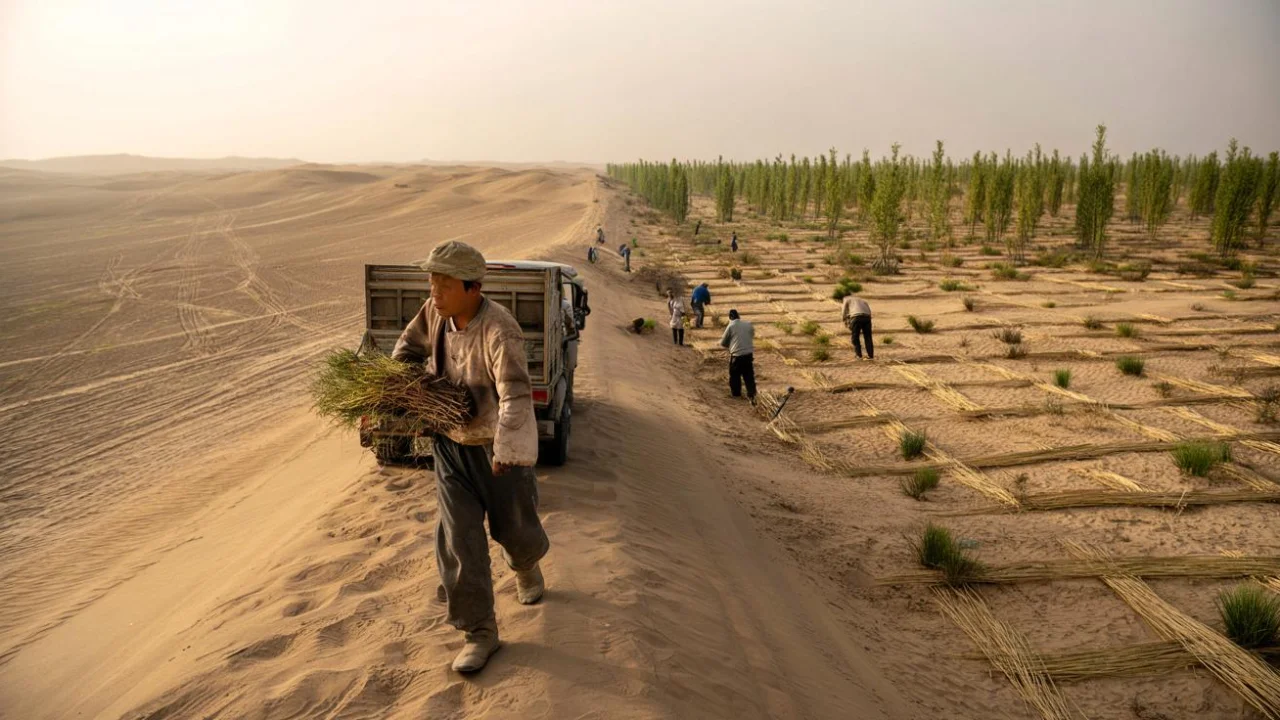
Zhang Wei still remembers the day his grandmother couldn’t hang the washing outside. It was 1995, and another sandstorm had rolled across their village in northern China, turning the sky an angry orange and coating everything in grit. His grandmother, who had weathered decades of these storms, just shook her head and muttered about how the desert was winning.

Today, Zhang’s own children play in the same courtyard where dust once piled like snow. The difference? Rows of young trees now stand between their village and the advancing sand, part of China’s massive campaign to push back against creeping deserts.
What happened here is part of something much bigger. Since the 1990s, China has planted over 1 billion trees in one of the world’s most ambitious desert reforestation efforts, fundamentally changing landscapes that seemed doomed to turn to dust.

How China Decided to Fight Back Against the Sand
In the early 1990s, China faced a crisis most people couldn’t see coming. Deserts were expanding at an alarming rate, swallowing farmland and sending massive dust storms as far as Beijing. The Gobi Desert and others were creeping south like a slow-motion tsunami, claiming 10,000 square kilometers of land each year.
“We realized we couldn’t just watch our country turn into a sandbox,” explains Dr. Li Xiaoming, a forestry researcher who has tracked China desert reforestation efforts for over two decades. “The choice was simple: fight back or lose everything.”
The solution wasn’t complex in theory, but staggering in scale. China launched multiple reforestation programs, including the famous “Great Green Wall” project. The idea was straightforward: plant enough trees to create barriers against advancing sand, stabilize soil, and gradually restore degraded landscapes.
But here’s what makes this story remarkable – it’s actually working. Satellite data shows that China has successfully slowed desert expansion in multiple regions and even reversed desertification in some areas.

The Numbers Behind China’s Green Revolution
The scale of China’s desert reforestation efforts becomes clear when you look at the data. This isn’t just about planting a few trees in parks – it’s a complete reshaping of northern China’s landscape.
| Program Component | Achievement | Timeframe |
|---|---|---|
| Trees Planted | Over 1 billion | 1990s-present |
| Land Restored | 25 million hectares | 1999-2019 |
| Desert Expansion Rate | Reduced by 65% | Compared to 1990s |
| Dust Storm Days in Beijing | Dropped from 26 to 3 per year | 1990s vs 2020s |
The most successful projects have focused on these key strategies:
- Planting drought-resistant tree species like poplars and acacias
- Creating shelter belts to protect agricultural land
- Establishing grass grids to stabilize sand dunes
- Combining trees with shrubs and grasses for ecosystem diversity
- Using both natural regeneration and active planting
“The secret isn’t just planting trees randomly,” notes environmental scientist Dr. Chen Mei. “It’s about choosing the right species for each location and creating entire ecosystems that can sustain themselves.”
Some regions have seen dramatic transformations. The Mu Us Desert, once considered hopeless, now has green patches visible from space. The Kubuqi Desert has shrunk by one-third since serious reforestation began.
Real Lives Changed by Green Walls
Behind every statistic is a human story. In Inner Mongolia, herder Batbayar talks about how his sheep now graze on land that was barren sand when his father was young. “My children think grass has always grown here,” he laughs. “They don’t know what it was like before the trees came.”
Farmers who once abandoned their land due to encroaching sand have returned. Villages that regularly evacuated during dust storms now host weekend tourists who come to see the “desert that became a forest.”
The economic impact ripples outward. New forests provide jobs for tree planters, forest guards, and eco-tourism operators. Agricultural productivity has increased in protected areas. Property values in formerly threatened communities have stabilized and even grown.
“My uncle used to say we’d have to move to the city because the desert would take our farm,” says Wang Lei, whose family has farmed the same land for generations. “Now my kids are planting their own trees and talking about expanding our orchards.”
The health benefits are equally significant. Reduced dust storms mean fewer respiratory problems, especially for children and elderly residents. Air quality in northern Chinese cities has improved partly due to reduced desert dust.
But the project hasn’t been without challenges. Some early plantings failed when drought hit or when planners chose inappropriate species. Monoculture forests sometimes created new problems, supporting pest outbreaks or depleting groundwater.
“We learned by doing,” admits forestry official Zhang Ping. “Not every tree survived, but we kept adjusting our approach based on what worked and what didn’t.”
The most successful projects now emphasize biodiversity, mixing native trees with shrubs and grasses to create resilient ecosystems. Water management has become more sophisticated, using drip irrigation and selecting plants that thrive with minimal water.
Climate scientists point out that China desert reforestation efforts provide a model for other countries facing similar challenges. Parts of Africa, the Middle East, and even the southwestern United States could potentially adapt China’s techniques to their own desert expansion problems.
Looking ahead, China plans to continue expanding these efforts, with goals to restore millions more hectares by 2030. The focus is shifting toward maintaining existing forests while carefully expanding into new areas where conditions are suitable.
FAQs
How many trees has China actually planted to fight desertification?
China reports planting over 1 billion trees since the 1990s as part of various anti-desertification programs, though this includes both direct planting and natural regeneration in restored areas.
Has China’s reforestation really stopped desert expansion?
Yes, satellite data confirms that desert expansion has slowed dramatically in treated areas, with some regions showing actual reversal of desertification for the first time in decades.
What types of trees work best in desert reforestation?
Drought-resistant native species like certain poplars, acacias, and local shrubs have shown the best survival rates, especially when planted as part of mixed ecosystems rather than monocultures.
Could other countries copy China’s approach?
Many techniques are transferable, but success depends on local climate, soil conditions, and water availability. The key is adapting the approach rather than copying it exactly.
How long does it take for planted trees to actually stop desert expansion?
Initial soil stabilization can begin within 2-3 years, but creating effective barriers against sand movement typically requires 5-10 years as trees mature and root systems develop.
What are the biggest challenges in desert reforestation?
Water scarcity is the primary challenge, followed by choosing appropriate species, preventing overgrazing, and maintaining planted areas during drought periods.
About the Author
