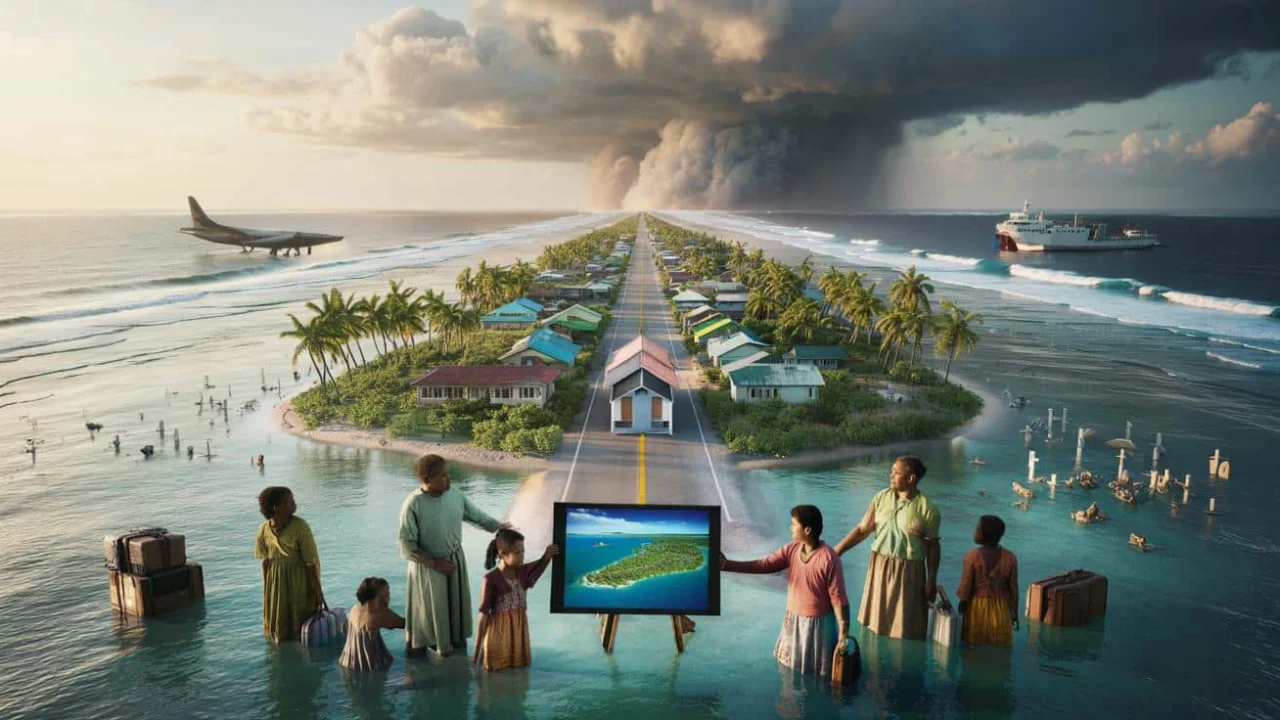
Maria Tekai remembers the day the ocean first entered her kitchen. She was preparing breakfast for her grandchildren when salty water began seeping through the floorboards of her home in Funafuti, Tuvalu’s capital. “The tide wasn’t even that high,” she recalls, watching the water pool around her feet. “But somehow, the sea had found its way inside.” That morning changed everything for Maria’s family—and for an entire nation that’s now preparing for the unthinkable.
What happened to Maria is happening across Tuvalu, a tiny Pacific nation where 11,000 people are watching their homeland disappear beneath rising seas. This isn’t a distant threat or a future possibility. It’s happening right now, and Tuvalu has made a decision no country has ever made before: planning its own evacuation.
The First Nation to Plan Its Own Climate Escape
Tuvalu sits just a few meters above sea level on nine coral atolls scattered across the Pacific. The highest point in the entire country is barely 4.5 meters above the waves. When NASA scientists measured sea level changes around Tuvalu, they found the ocean has risen 15 centimeters compared to the previous thirty-year average. On most coastlines, that might sound manageable. On a coral atoll, it’s a death sentence.
The Tuvalu climate evacuation plan represents something unprecedented in human history. Never before has an entire sovereign nation formally prepared to relocate its people because of climate change. The small island nation has partnered with Australia to create what they call a “climate mobility visa”—a legal pathway for Tuvaluans to permanently relocate before their islands become uninhabitable.
“We’re not waiting for the water to reach our doorsteps,” explains Tuvalu’s Prime Minister. “We’re taking control of our future while we still can.”
The crisis touches every aspect of daily life. Saltwater now contaminates the freshwater wells that communities have depended on for generations. The national airport floods regularly, cutting off the country’s only connection to the outside world. Schools close when king tides surge across entire islands. Even the dead aren’t safe—rising seas have begun washing away graveyards where ancestors were buried above what used to be the high-tide line.
How the Historic Australia-Tuvalu Agreement Works
The partnership between Australia and Tuvalu, called the Falepili Union, creates the world’s first climate migration treaty. Here’s how this groundbreaking agreement operates:
| Program Feature | Details |
|---|---|
| Annual Visa Allocation | 280 Tuvaluans per year |
| Selection Process | Lottery system for fairness |
| Legal Status | Permanent residents with full rights |
| Access to Services | Healthcare, education, employment |
| Family Reunification | Pathways for extended families |
| Duration | Long-term commitment, renewable |
The response has been overwhelming. In the first application round, nearly 8,750 people applied—more than a third of Tuvalu’s entire population. These numbers reveal both the desperation and the hope driving the Tuvalu climate evacuation. Families are making impossible choices about whether to stay and fight for their homeland or secure a future for their children elsewhere.
“This isn’t just about moving people,” notes climate migration expert Dr. Sarah Chen. “It’s about preserving a culture, a language, and an entire way of life that could be lost forever.”

Key features of the program include:
- Priority consideration for families with children
- Skills-based pathways for working-age adults
- Cultural preservation programs in Australia
- Continued citizenship rights in Tuvalu
- Support for seasonal workers and students
What This Means for Climate Migration Worldwide
The Tuvalu climate evacuation sets a precedent that could reshape how the world handles climate displacement. Currently, international law doesn’t recognize “climate refugees”—people forced to flee environmental disasters have no automatic right to protection in other countries.
This agreement changes that equation. It treats climate migration as a managed process rather than an emergency response. Instead of waiting for catastrophe and then scrambling to help refugees, Australia and Tuvalu are creating orderly pathways for relocation while people still have choices.
“We’re essentially watching the birth of climate diplomacy,” observes international relations professor Dr. Michael Torres. “Other small island nations are already studying this model.”
The implications extend far beyond the Pacific. Climate change is creating displacement pressures worldwide:
- Small island nations in the Caribbean face similar sea-level threats
- Coastal communities from Bangladesh to Miami are planning retreats
- Drought-stricken regions in Africa are experiencing mass migration
- Arctic communities are losing permafrost foundations
But the Tuvalu model faces significant challenges. Critics question whether 280 visas per year will be enough if sea-level rise accelerates. Others worry about brain drain, as the most educated and skilled Tuvaluans may be the first to leave.
“Every person who leaves takes knowledge, connections, and cultural memory with them,” explains anthropologist Dr. Lisa Rangi. “How do you maintain a nation when your people are scattered across the globe?”
The agreement also raises complex questions about sovereignty and identity. If Tuvalu’s land disappears entirely, can it still be considered a country? Will Tuvaluan culture survive in Australian suburbs? These aren’t just legal puzzles—they’re deeply personal questions about what it means to belong somewhere.
For families like Maria’s, the choice isn’t easy. Her daughter wants to apply for the program to give her children better educational opportunities. But Maria can’t imagine leaving the place where her grandparents are buried, where her family has fished the same lagoons for generations.
The Tuvalu climate evacuation represents both an ending and a beginning. It’s the story of a nation that refused to simply disappear, choosing instead to write its own next chapter. Whether other countries will follow this model—and whether it will ultimately preserve what makes Tuvalu unique—remains to be seen.
FAQs
Why is Tuvalu the first country to plan a climate evacuation?
Tuvalu sits only a few meters above sea level, making it extremely vulnerable to rising seas that are already flooding homes and contaminating freshwater supplies.
How many people can relocate to Australia each year?
The agreement allows 280 Tuvaluans to receive climate mobility visas annually through a lottery system.
Will evacuated Tuvaluans still be considered citizens of their home country?
Yes, the agreement allows people to maintain Tuvaluan citizenship while becoming permanent residents of Australia.
What happens if more than 280 people want to leave each year?
The program uses a lottery system to fairly distribute the limited number of visas among applicants.
Could other island nations create similar agreements?
Yes, this treaty could serve as a model for other climate-vulnerable countries negotiating with larger neighbors for migration partnerships.
What support do relocated Tuvaluans receive in Australia?
They get access to healthcare, education, and employment on the same terms as permanent residents, plus cultural preservation programs.
About the Author
