Picture this: you’re sitting at your kitchen table, scrolling through photos on your phone after a family camping trip. You expect to see the usual shots of tents and campfires, but suddenly there’s an image that stops you cold—something completely unexpected that makes you lean forward and squint at the screen. That’s exactly what happened to marine researchers in Antarctica, except instead of vacation photos, they were reviewing footage from the ocean floor.
What they found wasn’t supposed to exist. Beneath the thick ice of the Weddell Sea, where temperatures hover around freezing and sunlight never reaches, thousands of carefully constructed fish nests covered the seafloor like an underwater subdivision. It was a discovery that would rewrite what scientists thought they knew about life in one of Earth’s most hostile environments.
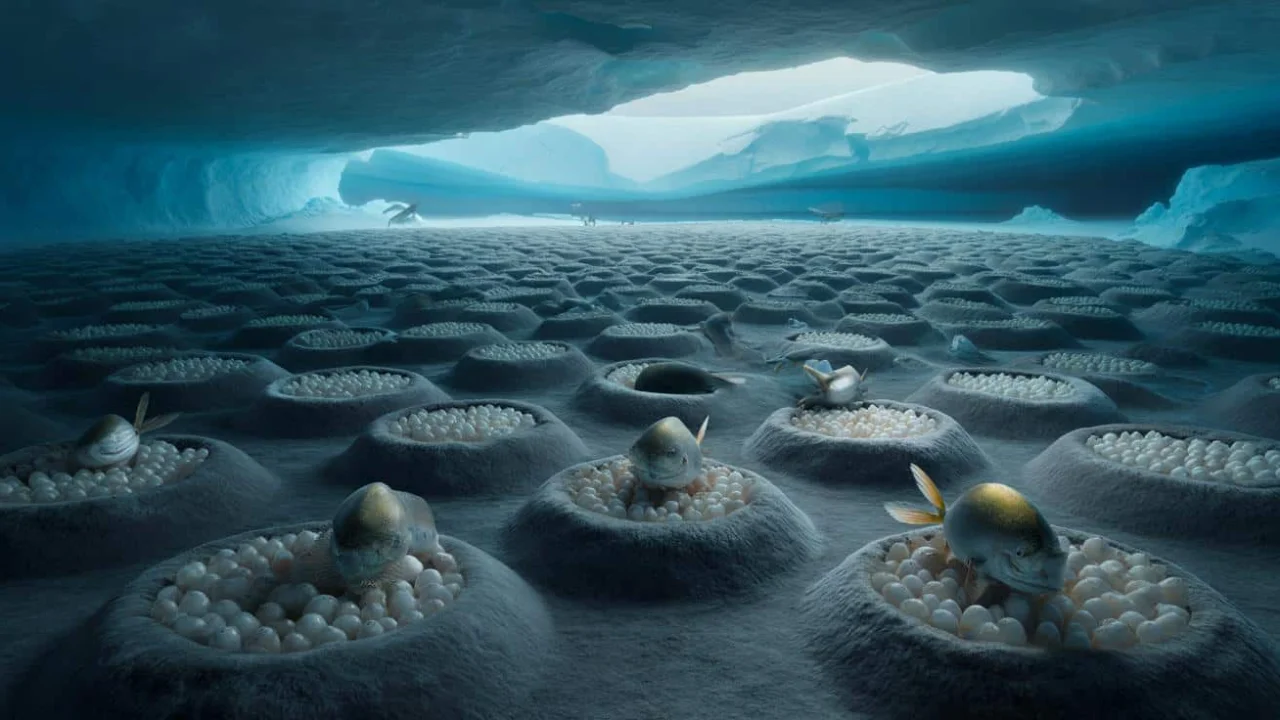
These weren’t just random holes in the mud. Each nest was a perfect circle, meticulously cleared of debris, with a devoted parent fish standing guard over precious eggs.

When a Shipwreck Hunt Revealed an Underwater City
The story behind the discovery of these fish nests beneath Antarctic ice reads like something from an adventure novel. Scientists aboard the South African research vessel SA Agulhas II weren’t looking for fish at all—they were hunting for Ernest Shackleton’s legendary ship, the Endurance, which had been trapped in ice since 1915.
Using a remotely operated vehicle nicknamed “Lassie,” the team lowered cameras through the thick sea ice into the pitch-black depths of the Weddell Sea. They expected to find mud, maybe some ship debris, and little else in this frozen wasteland.
Instead, their cameras revealed an astonishing sight: an organized landscape of thousands of circular depressions stretching as far as the lights could reach. Each depression was about two feet wide and perfectly maintained, like someone had been busy with an underwater vacuum cleaner.
“We couldn’t believe what we were seeing,” said lead researcher Dr. Sarah Collins, who first reviewed the footage. “It was like discovering a hidden city beneath the ice—except this city was built and maintained by fish.”

The fish nests appeared in every direction the cameras turned. Some stood alone like isolated homesteads, while others clustered together in crescents, lines, and geometric patterns that suggested complex social organization.
The Iceberg That Accidentally Opened a Window to Hidden Life
This remarkable discovery of fish nests beneath Antarctic ice was only possible because of a dramatic natural event that occurred years earlier. In 2017, the massive iceberg A68—roughly the size of Delaware—broke away from the Larsen C ice shelf, exposing 5,800 square kilometers of ocean that had been sealed under ice for potentially thousands of years.

The iceberg’s departure created a rare opportunity for researchers to explore previously inaccessible waters before new sea ice could form. What they found challenged every assumption about life in Antarctica’s harshest environments.
Here’s what made this discovery so extraordinary:
- The nesting ground spans over 240 square kilometers—larger than many major cities
- An estimated 60 million active nests cover the seafloor
- Each nest contains 1,000-2,000 eggs carefully tended by parent fish
- Water temperatures remain below freezing year-round
- No sunlight has reached this area in recorded history
“The scale is mind-blowing,” explains marine biologist Dr. James Morrison. “We’re talking about one of the largest fish breeding colonies ever discovered, thriving in conditions that should theoretically be too harsh to support such complex behavior.”
| Discovery Details | Measurements |
|---|---|
| Total nesting area | 240 square kilometers |
| Estimated number of nests | 60 million |
| Average nest diameter | 75 centimeters |
| Water temperature | -1.8°C to 0°C |
| Depth | 420-535 meters |
| Eggs per nest | 1,000-2,000 |
The fish responsible for these architectural marvels are small polar cod called Lindbergichthys nudifrons. About the size of a human hand, these remarkable creatures have evolved antifreeze proteins in their blood to survive in sub-zero waters that would kill most other fish species.
What This Discovery Means for Our Understanding of Life on Earth
The existence of these massive fish nests beneath Antarctic ice forces scientists to reconsider fundamental assumptions about life in extreme environments. This discovery suggests that even the planet’s most inhospitable regions can support complex social behaviors and large-scale ecosystem engineering.
The implications stretch far beyond marine biology. Climate researchers are now scrambling to understand how these delicate ecosystems might respond to warming Antarctic waters. The nesting grounds represent a massive carbon reservoir—both in the fish themselves and in the organic matter they’ve carefully arranged on the seafloor.
“This discovery changes everything we thought we knew about Antarctic marine ecosystems,” notes polar ecologist Dr. Maria Petrov. “These fish have been quietly building underwater cities while we assumed nothing could thrive in such conditions.”
For conservation efforts, the findings present both opportunities and challenges. The nesting grounds clearly represent a critical habitat that needs protection, but they exist in one of the most remote and inaccessible regions on Earth. Traditional marine protected area strategies may need to be completely reimagined for such environments.
The discovery also raises intriguing questions about similar hidden ecosystems that might exist beneath other ice shelves around Antarctica. With climate change causing more icebergs to calve and expose previously hidden ocean areas, researchers are rushing to explore these newly accessible regions before environmental changes alter them forever.
“We’re essentially racing against time,” explains Dr. Collins. “Each iceberg that breaks away gives us a brief window to explore ecosystems that have been hidden for millennia. Who knows what other surprises are waiting beneath the ice?”
The fish nests beneath Antarctic ice also provide crucial insights into how marine life might adapt to changing ocean conditions. As global temperatures rise and ice patterns shift, understanding how these resilient creatures build and maintain their communities could inform conservation strategies for other vulnerable species worldwide.
FAQs
How big are these fish nests beneath Antarctic ice?
Each individual nest is about 75 centimeters (roughly 2.5 feet) in diameter, but the entire nesting ground covers 240 square kilometers—larger than most major cities.
What kind of fish build these Antarctic nests?
The nests belong to Lindbergichthys nudifrons, small polar cod about the size of a human hand that have evolved special antifreeze proteins to survive in sub-zero waters.
How many fish nests were discovered under the ice?
Researchers estimate there are approximately 60 million active nests in the newly discovered breeding ground, making it one of the largest fish colonies ever found.
Why weren’t these nests discovered before?
The area was completely sealed under thick ice for potentially thousands of years until the giant iceberg A68 broke away in 2017, finally allowing researchers to access this hidden underwater world.
How do fish survive in such cold Antarctic waters?
These polar fish have evolved remarkable adaptations including antifreeze proteins in their blood that prevent ice crystals from forming, allowing them to thrive in waters below 0°C.
What does this discovery mean for climate change research?
The massive nesting grounds represent a significant carbon reservoir and demonstrate how climate change might affect previously unknown ecosystems as more Antarctic ice melts and exposes hidden marine habitats.
About the Author
