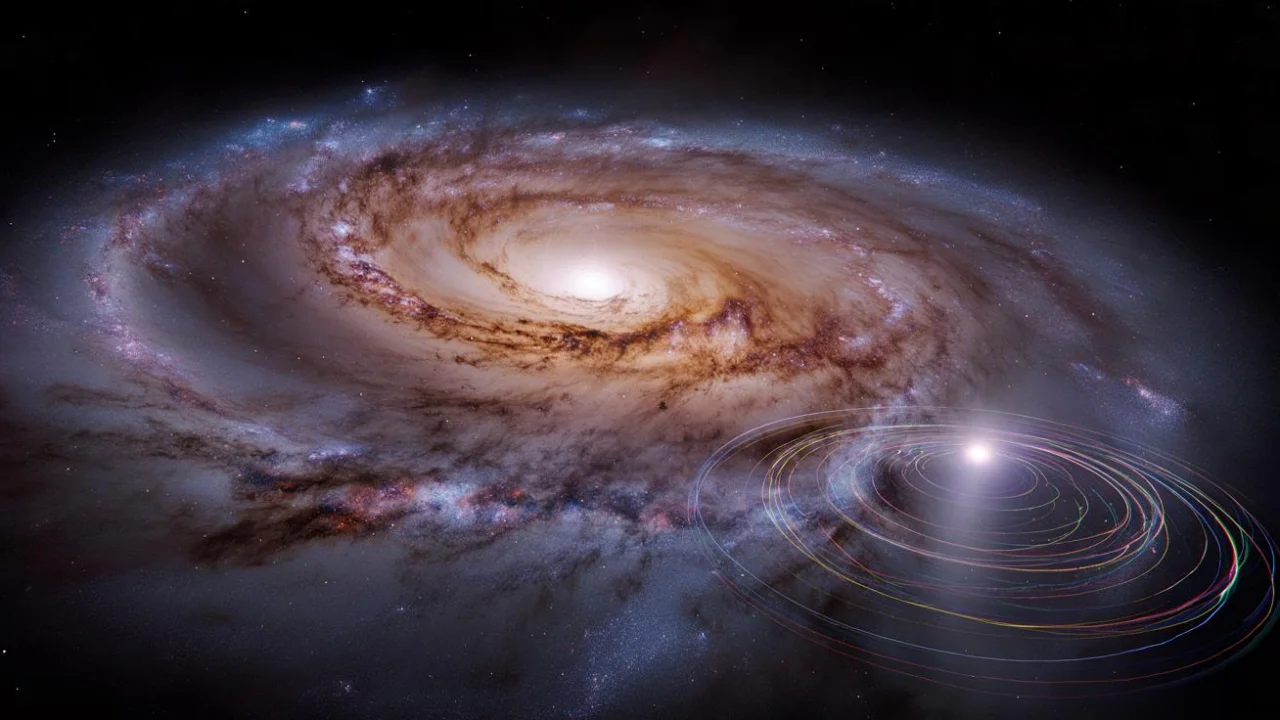
Picture this: you’re scrolling through your phone late at night, and suddenly you get a text from an unknown number. The message doesn’t make sense, but it keeps coming—the same strange pattern, over and over again, for months. You’d probably think someone was trying to tell you something important, right?

That’s essentially what happened to astronomers in 2024, except their mysterious messenger was located 2 billion light-years away. What they discovered has completely upended everything we thought we knew about the universe’s most powerful radio signals.
The signal in question isn’t from your typical cosmic neighbor. It’s shaking the very foundations of astrophysics, and frankly, it’s got scientists scratching their heads in ways they haven’t since the discovery of dark matter.

When the Universe Breaks Its Own Rules
Fast radio bursts have been puzzling astronomers since their discovery in 2007. These cosmic phenomena are like the universe’s version of a camera flash—incredibly bright, impossibly brief, and packed with more energy than our Sun produces in an entire year.
Most fast radio bursts follow a simple pattern: they appear, blast their energy across space in milliseconds, and then vanish forever. Think of them as cosmic one-hit wonders. But FRB 20240209A decided to be different.

“We’ve never seen anything quite like this before,” explains Dr. Sarah Mitchell, a radio astronomer at the University of California. “Most fast radio bursts are like fireworks—spectacular but over in an instant. This one kept going off like an alarm clock.”
Northwestern University astronomers first detected this rebellious signal in February 2024. Instead of disappearing, it kept repeating through July, giving researchers an unprecedented opportunity to study it in detail. Each repetition provided more clues about its origin, brightness patterns, and the cosmic environment it came from.

The repetitive nature made FRB 20240209A incredibly valuable to scientists. Unlike typical fast radio bursts that leave researchers with just a single snapshot, this signal offered a whole photo album of data to analyze.
The Data That Changed Everything
Using multiple telescope networks across the globe, researchers traced FRB 20240209A to its source galaxy. What they found there completely contradicted decades of established theory about where fast radio bursts should originate.

Here’s what makes this discovery so revolutionary:
| Expected FRB Environment | FRB 20240209A’s Actual Environment |
|---|---|
| Young, active star-forming galaxy | Old, “dead” quiescent galaxy |
| High rate of stellar birth | Minimal star formation |
| Abundant gas and cosmic material | Depleted gas reserves |
| Many magnetars and neutron stars | Fewer exotic stellar objects |
The signal’s host galaxy sits approximately 2 billion light-years from Earth. To put that distance in perspective, the radio waves we’re detecting today began their journey when the most complex life on our planet was still just primitive multicellular organisms.
Key characteristics of this groundbreaking discovery include:
- Duration: Active for at least five months (February-July 2024)
- Energy output: Equivalent to our Sun’s annual energy production per burst
- Frequency: Multiple detections per observation session
- Location precision: Pinpointed to a specific region within its host galaxy
- Galaxy type: Quiescent, low star-formation rate environment
“The math just doesn’t add up,” notes Dr. James Rodriguez, an astrophysicist at MIT. “We built our models around the idea that these bursts need young, energetic environments to form. This discovery is forcing us to go back to the drawing board.”
What This Means for Our Understanding of Space
This discovery isn’t just academic curiosity—it has real implications for how we understand the universe and our place in it. Fast radio bursts serve as cosmic lighthouses, helping scientists map the structure of space and understand the distribution of matter between galaxies.
The traditional model suggested that fast radio bursts originated from magnetars—neutron stars with magnetic fields trillions of times stronger than Earth’s. These exotic objects typically form in environments where massive stars are constantly being born, living brief lives, and exploding as supernovas.
But FRB 20240209A’s “dead” galaxy host challenges this entire framework. If fast radio bursts can emerge from quiet, mature galaxies, it suggests there are multiple pathways for creating these powerful signals—pathways we haven’t discovered yet.
This has practical consequences for astronomy. Scientists use fast radio bursts to study the invisible matter between galaxies, measure cosmic expansion, and even search for signs of extraterrestrial intelligence. If our understanding of where these signals come from is wrong, it affects all of these applications.
“We’re essentially learning that the universe has more tricks up its sleeve than we realized,” explains Dr. Lisa Chen, a cosmologist at Stanford University. “Every time we think we’ve got things figured out, space throws us another curveball.”
The discovery also impacts our search for alien civilizations. Some scientists have speculated that repeating fast radio bursts might be artificial signals from advanced alien technologies. While FRB 20240209A is almost certainly natural, its unexpected behavior reminds us how much we still don’t know about cosmic phenomena.
Looking forward, this finding will likely trigger a wave of new research. Astronomers will need to develop new theories about stellar remnants in quiet galaxies, reexamine existing fast radio burst data, and adjust their search strategies for finding more of these signals.
The universe just got a little more mysterious, and frankly, that’s exactly the kind of mystery that makes space exploration so thrilling. Every answer we find seems to unlock ten new questions, and FRB 20240209A has just handed us a whole new set of cosmic puzzles to solve.
FAQs
What exactly are fast radio bursts?
Fast radio bursts are extremely brief but powerful flashes of radio waves from space that release as much energy as our Sun produces in a year, all in just milliseconds.
How far away was FRB 20240209A detected?
The signal originated from a galaxy approximately 2 billion light-years away from Earth, meaning the radio waves traveled for 2 billion years before reaching our telescopes.
Why is this particular fast radio burst so unusual?
Unlike most fast radio bursts that appear once and disappear forever, FRB 20240209A repeated for months and came from an old, inactive galaxy instead of a young, star-forming one.
Could this signal be from aliens?
While scientists can’t rule out artificial origins completely, the signal’s characteristics strongly suggest it’s a natural cosmic phenomenon rather than alien technology.
How do astronomers detect these signals?
Scientists use networks of radio telescopes around the world that constantly monitor the sky for unusual radio wave patterns and bursts.
What happens next in this research?
Astronomers will continue monitoring for similar signals, develop new theories about their origins, and potentially revise our understanding of how these powerful cosmic events form.
About the Author
