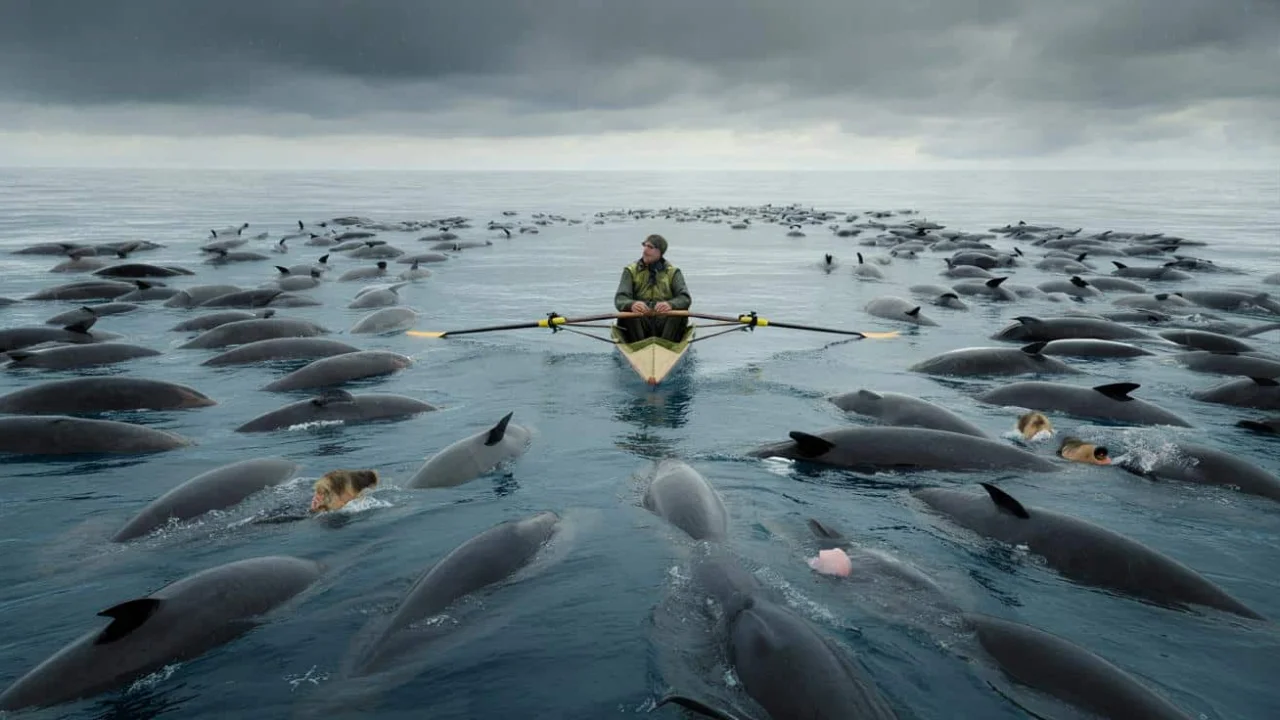
Picture this: You’re thousands of miles from the nearest coastline, alone on a vast ocean with nothing but your tiny rowing boat and the endless horizon. The silence is deafening. Then, suddenly, the water around you begins to bubble and churn as if the sea itself is coming alive.
That’s exactly what happened to Tom Waddington, a British ski instructor who found himself in the middle of one of the most extraordinary whale encounters ever recorded. What started as another grueling day of solo ocean rowing turned into a heart-stopping spectacle that would leave anyone speechless.
Sometimes the ocean reminds us just how small we really are in this world.

When the Ocean Came Alive Around a Tiny Boat
Tom Waddington was more than 2,000 nautical miles from land, rowing across the North Atlantic from Newfoundland to England’s southwest coast. After weeks of battling waves, wind, and his own exhaustion, he thought he’d seen it all.
But on this particular day, something felt different. The morning had been miserable – cold, rainy, and relentless. As the afternoon wore on, the wind died down to an eerie calm. That’s when Waddington noticed the water around his seven-meter boat starting to ripple in ways he’d never seen before.

“At first, I thought it might be dolphins,” he later recalled. “You see them fairly often on ocean crossings. But within minutes, I realized this was something completely different.”
Dark, rounded heads began breaking the surface in every direction. Long, elegant fins cut through the water like living torpedoes. What Waddington was witnessing was a massive congregation of long-finned pilot whales – nearly 1,000 of them, all gathering around his tiny vessel.

The whale encounter unfolded like something from a nature documentary. These magnificent creatures glided alongside his boat, surfaced just meters away, and even crossed beneath his hull. Some rolled onto their sides, bringing their massive eyes close to the boat as if they were trying to figure out what this strange floating object was doing in their territory.
Understanding These Ocean Giants and Their Behavior
Long-finned pilot whales aren’t actually whales at all – they’re the largest members of the dolphin family. But don’t let that fool you. These creatures are impressive by any standard:

- Adults can reach up to 7 meters in length
- They can weigh several tonnes each
- Their distinctive rounded heads and stocky bodies often confuse people
- They’re found in deep, cold waters across the North Atlantic
- They’re known for their incredibly strong family bonds
What makes this whale encounter so remarkable isn’t just the sheer number of animals involved. It’s the behavior they displayed. Marine biologists who studied Waddington’s footage were fascinated by how the whales seemed genuinely curious about the boat, rather than threatened or aggressive.
“These animals are intensely social,” explains Dr. Sarah Mitchell, a marine mammal specialist. “They travel in tight-knit family units that rarely separate. When several families come together, you can get these massive congregations.”
| Whale Behavior | What Waddington Observed |
|---|---|
| Curiosity Investigation | Rolling on sides to examine the boat with their eyes |
| Group Coordination | Moving as one massive, coordinated unit |
| Non-threatening Approach | Coming close without aggressive posturing |
| Extended Interaction | Staying around the boat for an extended period |
“What Tom experienced is extraordinarily rare,” says marine researcher James Crawford. “Most whale encounters last minutes, not hours. The fact that they stayed around his boat for so long suggests they were genuinely intrigued.”
Why This Encounter Matters for Ocean Conservation
This incredible whale encounter offers us a glimpse into behaviors we rarely get to witness. When nearly 1,000 pilot whales decide to investigate a human, it tells us something important about these animals’ intelligence and social structure.
Pilot whales face numerous threats in today’s oceans. Climate change is altering their food sources, while shipping traffic and underwater noise pollution disrupt their communication and navigation. Mass strandings of pilot whales have become more frequent, though scientists still don’t fully understand why.
“Events like this remind us that we’re sharing the ocean with incredibly sophisticated animals,” notes conservation biologist Dr. Emma Thompson. “Their curiosity toward humans suggests a level of intelligence we’re only beginning to understand.”
The encounter also highlights how much we still don’t know about whale behavior. Why did so many families come together? What prompted their curiosity about Waddington’s boat? These questions drive important research that helps us protect these magnificent creatures.
For ocean rowers like Waddington, such encounters are becoming rarer as shipping lanes become busier and ocean noise increases. Every peaceful interaction between humans and whales becomes more precious.
The footage from this whale encounter is now being studied by researchers who hope to learn more about pilot whale social structures and behavior patterns. It’s providing valuable data that could help protect these animals for future generations.
“Tom’s experience shows us what’s possible when we approach the ocean with respect,” says marine conservation expert Dr. Michael Roberts. “These whales chose to investigate rather than avoid human presence, which suggests they don’t automatically see us as a threat.”
As Waddington continued his journey after the whales eventually moved on, he carried with him not just an incredible memory, but footage that’s contributing to our understanding of these remarkable ocean inhabitants.
FAQs
How common are whale encounters for ocean rowers?
While whale sightings happen occasionally, encounters with nearly 1,000 whales are extremely rare and represent once-in-a-lifetime experiences.
Are pilot whales dangerous to humans?
Pilot whales are generally not aggressive toward humans and this encounter showed curious, peaceful behavior rather than any threatening actions.
Why do pilot whales travel in such large groups?
They’re highly social animals that form tight family bonds, and multiple family units sometimes merge to create massive congregations of hundreds or even thousands of individuals.
How long do whale encounters typically last?
Most whale encounters last only a few minutes, making Waddington’s extended interaction particularly extraordinary and scientifically valuable.
What should someone do if they encounter whales while boating?
Maintain a respectful distance, avoid sudden movements, and never attempt to touch or feed the animals while enjoying the rare opportunity to observe them.
Can this type of whale encounter help with conservation efforts?
Yes, footage and data from such encounters provide valuable insights into whale behavior and social structures that help scientists develop better conservation strategies.
About the Author