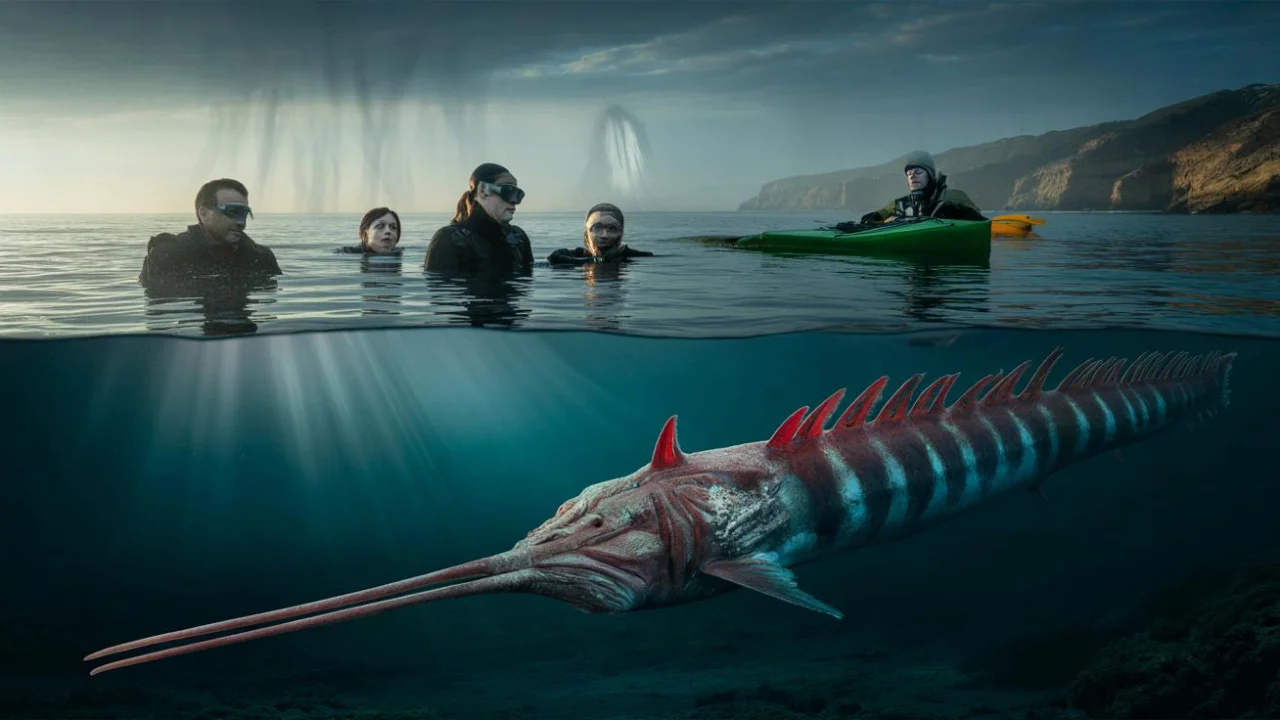
Maria Gonzalez was enjoying her morning kayak routine off La Jolla Cove when she spotted what looked like a massive piece of silver tinfoil floating in the water. As she paddled closer, her heart started racing. The shimmering object was undulating gently with the waves, and she realized this wasn’t debris at all.

“I’ve been kayaking these waters for fifteen years,” Maria later told her neighbors. “I’ve never seen anything like it.” What she had discovered was a dead oarfish, stretching over ten feet long, its ribbon-like body catching the morning sunlight like a metallic banner from another world.
Two days later, a 4.4 magnitude earthquake rattled Los Angeles. Suddenly, Maria’s strange encounter took on a much more ominous meaning, as whispers of an ancient legend began spreading across social media faster than the seismic waves themselves.

The “Doomsday Fish” That Has Scientists Divided
The oarfish earthquakes connection isn’t just internet folklore. For centuries, coastal communities in Japan, Chile, and other earthquake-prone regions have passed down stories about these mysterious deep-sea giants appearing before major disasters. The fish’s dramatic nickname, “Doomsday Fish,” reflects the genuine fear and respect these sightings can generate.
Oarfish normally live in the ocean’s twilight zone, 600 to 3,000 feet below the surface, where sunlight never penetrates. They’re among the longest bony fish in the world, with some specimens reaching nearly 36 feet in length. Their appearance at the surface is so rare that each sighting becomes a scientific event.

“When these fish wash up, it’s like receiving a message from the deep ocean,” explains Dr. Sarah Chen, a marine biologist at UC San Diego. “The question is whether we’re interpreting that message correctly.”
The timing of the San Diego discovery couldn’t have been more dramatic. On August 10, 2024, divers and kayakers at La Jolla Cove found the silvery giant floating lifeless in the water. Just 48 hours later, the Los Angeles area experienced its strongest earthquake in months, sending social media into overdrive with speculation about the connection.

What Science Really Knows About Oarfish Behavior
The oarfish earthquakes theory gained serious attention after the 2011 Japan earthquake and tsunami. In the months leading up to that devastating event, Japanese fishermen reported an unusual number of oarfish sightings along the coast. The coincidence was too striking to ignore, prompting researchers to investigate whether seismic activity could drive these deep-sea creatures to the surface.
Here’s what we know about these enigmatic fish and their potential connection to natural disasters:

- Sensitive to pressure changes: Oarfish may detect subtle shifts in water pressure that occur before earthquakes
- Deep-sea dwellers: They normally inhabit depths where tectonic activity could affect water temperature and currents
- Stress response: Geological disturbances might disrupt their food sources or cause disorientation
- Weak swimmers: Unlike other deep-sea fish, oarfish are poor swimmers and may struggle to return to depth once displaced
| Recent Oarfish Sightings | Location | Date | Subsequent Earthquake |
|---|---|---|---|
| La Jolla Cove | California | August 10, 2024 | 4.4 magnitude (2 days later) |
| Toyama Bay | Japan | December 2022 | 6.1 magnitude (1 week later) |
| Catalina Island | California | October 2019 | 4.5 magnitude (3 days later) |
| Multiple locations | Japan | Early 2011 | 9.1 magnitude tsunami (March 2011) |
“The correlation is fascinating, but correlation doesn’t equal causation,” warns Dr. Robert Kim, a seismologist at Caltech. “We need to be careful not to let pattern-seeking override scientific rigor.”
Why This Ancient Legend Still Matters Today
Whether or not oarfish can actually predict earthquakes, their appearances serve as powerful reminders of how much we still don’t understand about our planet’s interconnected systems. California residents, already living with constant earthquake awareness, find themselves paying closer attention to these rare deep-sea visitors.
The psychological impact is real. After the San Diego oarfish discovery and subsequent earthquake, local emergency preparedness groups reported a surge in earthquake kit purchases and family emergency plan discussions. Sometimes a legend can be more effective than official warnings in motivating people to prepare.
Marine biologists are also benefiting from increased public interest. Each oarfish sighting provides valuable research opportunities, allowing scientists to study these elusive creatures and better understand deep-ocean ecosystems. The Scripps Institution of Oceanography has been collecting tissue samples and conducting examinations that wouldn’t be possible without these rare surface appearances.
“Even if the earthquake connection proves false, oarfish sightings tell us something important is happening in the deep ocean,” notes Dr. Chen. “Climate change, pollution, and other factors could be driving these fish from their normal habitat.”
For coastal communities, the oarfish serves as a tangible link to the ocean’s mysteries. In an age of satellite tracking and digital monitoring, there’s something almost magical about a creature that seems to emerge from the depths bearing ancient warnings.
The truth is, we may never definitively prove or disprove the oarfish earthquakes connection. What matters is that these encounters remind us to respect both the ocean’s power and our planet’s geological forces. In earthquake country, any reminder to stay prepared isn’t superstition—it’s survival.
FAQs
How often do oarfish appear at the surface?
Oarfish sightings are extremely rare, with only a few documented cases per year worldwide.
Are oarfish dangerous to humans?
No, oarfish are completely harmless. They feed on small fish and squid and have no teeth capable of harming humans.
How long can oarfish grow?
The longest recorded oarfish measured nearly 36 feet, making them among the longest bony fish in the ocean.
Do scientists believe oarfish can predict earthquakes?
Most scientists remain skeptical, though some research suggests these fish may be sensitive to geological changes.
What should I do if I find an oarfish?
Contact your local marine biology institution or aquarium immediately, as these discoveries provide valuable research opportunities.
Have oarfish been found in other parts of the United States?
Yes, oarfish have been discovered along both the Pacific and Atlantic coasts, though West Coast sightings are more common.
About the Author