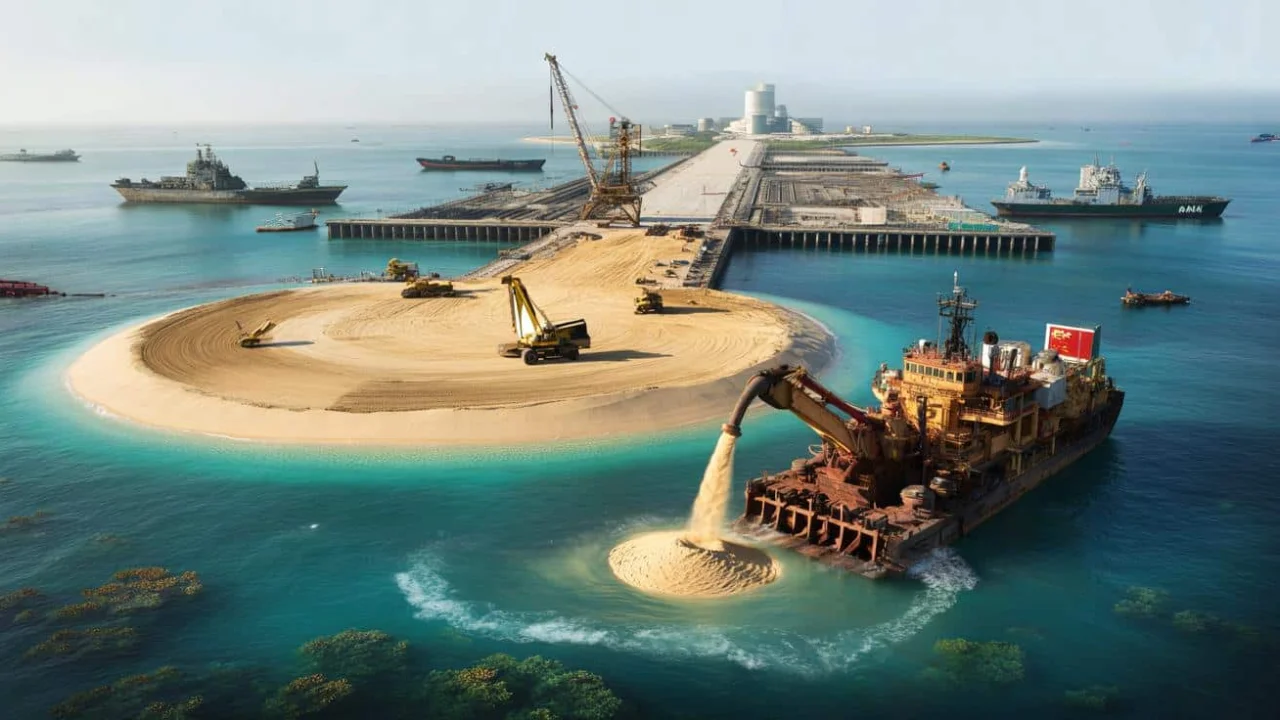
Maria Santos had been fishing these waters for thirty years when she first noticed something strange. Where her grandfather’s charts showed empty ocean, there was now a faint outline of sand beneath the waves. “I thought maybe the tide was playing tricks,” she recalls, adjusting her weathered cap. “But when I came back six months later, there were buildings where fish used to swim.”

She wasn’t imagining things. What Maria witnessed was one of the most audacious engineering projects of our time—China’s systematic creation of entirely new landmasses from nothing but ocean and ambition.
For over twelve years, massive dredging ships have been working around the clock, pumping millions of tons of sand and sediment into the South China Sea. The result? Seven major China artificial islands that have literally redrawn the map, transforming underwater reefs into military outposts, airports, and strategic footholds in one of the world’s most contested waterways.

When Ocean Becomes Real Estate
The scale of China’s island-building program defies easy comprehension. Between 2013 and 2016 alone, Chinese dredgers moved enough sand to fill over 1,500 Olympic swimming pools—every single day. What started as barely visible coral reefs at low tide have become sprawling artificial islands, some spanning over 300 acres.
“We’re witnessing the largest artificial island construction project in human history,” explains Dr. James Mitchell, a maritime security analyst. “These aren’t small patches of reclaimed land—these are fully functional military and civilian installations rising from the ocean floor.”

The transformation happens faster than most people realize. Satellite imagery shows Fiery Cross Reef growing from a tiny speck in 2012 to a 677-acre island with a 10,000-foot runway by 2015. Subi Reef expanded from virtually nothing to 976 acres in roughly the same timeframe.
The engineering process itself is deceptively straightforward but monumentally complex in execution. Giant dredging vessels position themselves over sandy areas of the seafloor, then use powerful suction equipment to vacuum up sediment. This sand-and-water mixture gets pumped through floating pipelines directly onto shallow reefs and shoals.

Layer by layer, the ocean floor rises. What emerges first is a muddy, unstable platform that looks more like a construction accident than future real estate. But crews work methodically, reinforcing the edges with rock barriers, installing drainage systems, and gradually building up the elevation until the new land stays dry even at high tide.
The Incredible Scale of Sand and Strategy
The numbers behind China’s artificial islands tell a story of unprecedented ambition:

| Island Name | Original Size | Current Size (Acres) | Key Features |
|---|---|---|---|
| Fiery Cross Reef | Underwater at high tide | 677 | 10,000-foot airstrip, port facilities |
| Subi Reef | 0.2 acres | 976 | Military installations, radar systems |
| Mischief Reef | 1.5 acres | 1,379 | Underground bunkers, missile systems |
But these China artificial islands aren’t just impressive engineering feats—they’re strategic chess pieces. Each installation extends China’s territorial claims and military reach hundreds of miles from the mainland.
- Military capabilities: Runways long enough for fighter jets and bombers
- Surveillance networks: Radar systems monitoring maritime and air traffic
- Naval facilities: Deep-water ports for military vessels
- Defensive systems: Surface-to-air missiles and anti-ship weapons
- Logistics hubs: Fuel storage, ammunition depots, and maintenance facilities
“These islands function like unsinkable aircraft carriers,” notes Captain Rebecca Chen, a former naval intelligence officer. “They project power across shipping lanes that carry one-third of global maritime trade.”
The construction timeline reveals the methodical nature of the project. Initial dredging typically takes 8-12 months per major reef. Infrastructure development follows in phases: basic runways and ports first, then military installations, finally civilian facilities like weather stations and communication towers.
The Ripple Effects Felt Around the World
Maria Santos isn’t the only one whose life has changed dramatically. Fishing communities across Southeast Asia report dramatic shifts in marine ecosystems, traditional fishing grounds, and navigation patterns.
“My catch has dropped by 60% since the dredging started,” says Vietnamese fisherman Nguyen Van Duc. “The artificial islands block our traditional routes, and the fish populations have moved elsewhere.”
The environmental impact extends far beyond fishing. Marine biologists estimate that China’s island construction has destroyed approximately 3,000 acres of coral reef—ecosystems that took thousands of years to develop.
Geopolitically, the China artificial islands have fundamentally altered the strategic balance in Southeast Asia. Countries like the Philippines, Vietnam, and Malaysia suddenly find Chinese military installations within what they consider their territorial waters.
International shipping has adapted to new realities. Commercial vessels now navigate around Chinese-controlled areas, adding time and fuel costs to global supply chains. Maritime insurance rates have increased for routes through disputed waters.
“We’re seeing a new form of territorial expansion,” explains Professor David Wong, a geopolitical analyst. “Instead of invading existing land, China is literally creating new territory in international waters.”
The precedent has other nations taking notice. Several countries have launched their own modest island-building programs, though none match China’s scale or speed.
For international law, the artificial islands pose complex questions. Traditional maritime boundaries assume natural landforms, not human-made installations. Legal experts debate whether artificially created land can generate the same territorial claims as naturally formed islands.
The human cost includes displaced fishing communities, altered shipping routes, and increased military tensions. Regional coast guards report more frequent confrontations between civilian vessels and Chinese naval patrols around the artificial islands.
Looking forward, satellite monitoring suggests China’s island construction has largely plateaued, but maintenance and expansion of existing facilities continues. The seven major installations now serve as permanent facts on the ground—or rather, facts in the water—that have permanently altered the geopolitical landscape of the South China Sea.
FAQs
How long did it take China to build these artificial islands?
The major construction phase lasted from 2013 to 2016, though preparation and ongoing development spans over 12 years total.
Are China’s artificial islands legal under international law?
This remains highly disputed, with international courts generally ruling against China’s territorial claims based on artificial islands.
How much did the island construction cost China?
Estimates suggest the program cost between $8-15 billion, though exact figures remain classified.
Can other countries visit these artificial islands?
China restricts access to most facilities, allowing only limited civilian activities like weather monitoring and fishing shelter.
What happens to the islands during typhoons?
The structures are built to withstand Category 4 storms, with reinforced seawalls and elevated infrastructure designed for extreme weather.
Do people actually live on these artificial islands?
Yes, rotating military personnel, construction workers, and some civilian staff maintain permanent populations ranging from 100-500 people per island.
About the Author