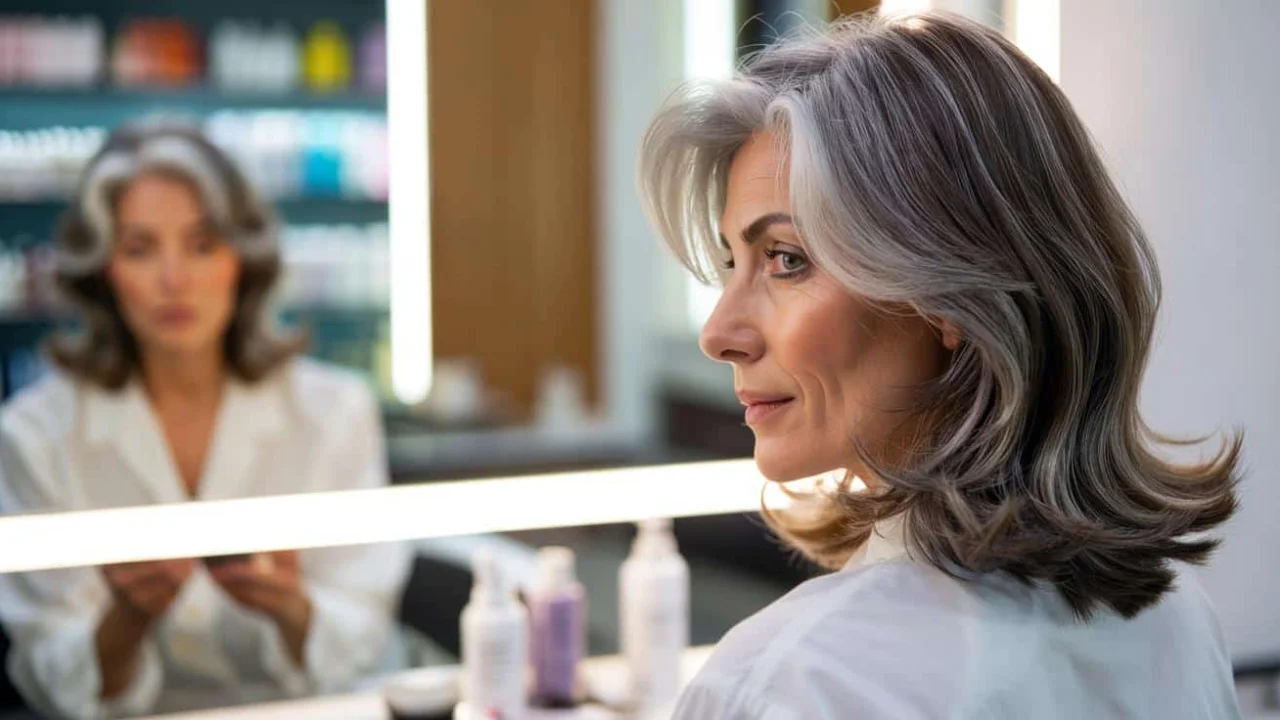
Sarah stared at her bathroom mirror, holding a box of auburn hair dye she’d been using for three years. The chemical smell from her last touch-up still lingered in her memory, along with the irritated scalp that took days to heal. At 42, she was coloring her roots every three weeks, and frankly, she was exhausted.

Then her yoga instructor walked in with the most gorgeous silver-streaked bob Sarah had ever seen. No harsh lines. No obvious regrowth. Just naturally beautiful hair that somehow made her look radiant and youthful. “What’s your secret?” Sarah asked after class.
“I stopped fighting my greys six months ago,” her instructor smiled. “Best decision I ever made.”

The Revolution Against Traditional Hair Dye
Across salons and social media platforms, a quiet revolution is reshaping how people approach grey hair coverage. The old model of harsh chemical dyes and monthly touch-ups is giving way to sophisticated techniques that work with natural silver strands rather than against them.
This shift represents more than just a beauty trend. It’s fundamentally changing how we view aging and self-care. Instead of seeing greys as something to eliminate, people are discovering ways to make them look intentional, healthy, and surprisingly youthful.
“I’ve seen a complete transformation in client requests over the past two years,” says colorist Maria Rodriguez from a popular New York salon. “People used to come in demanding full coverage. Now they ask how to make their greys look expensive.”
The techniques emerging from this movement focus on blending, glazing, and enhancing natural color variations. Rather than creating a uniform shade across the entire head, these methods add dimension and shine while softening harsh contrasts between grey and colored hair.

Modern Grey Hair Coverage Techniques That Actually Work
The new approach to grey hair coverage involves several innovative methods that prioritize hair health and natural-looking results:
- Grey blending: Uses lowlights and highlights to create seamless transitions between silver and original color
- Gloss treatments: Add shine and dimension without harsh chemicals, making greys look intentional
- Root shadowing: Softens regrowth lines by gradually darkening roots without full coverage
- Color melting: Creates smooth gradients that eliminate obvious demarcation lines
- Toning services: Neutralize yellow or brassy tones in grey hair for a more polished appearance

These techniques typically last longer than traditional dyes and cause significantly less damage to hair structure. Many clients report their hair feels healthier and stronger after making the switch.
| Traditional Dye Approach | Modern Grey Coverage |
|---|---|
| Full coverage every 3-4 weeks | Maintenance every 6-8 weeks |
| Harsh chemicals and ammonia | Gentler formulas and natural ingredients |
| Uniform color appearance | Natural dimension and movement |
| Hair damage and thinning | Improved hair health and shine |
| High maintenance costs | Lower long-term investment |
“The beauty industry is finally catching up to what people actually want,” explains hair health specialist Dr. Jennifer Chen. “Clients are prioritizing hair integrity over perfect color matches, and the results speak for themselves.”
Who’s Making the Switch and Why It Matters
The demographic embracing these new grey hair coverage methods spans far beyond what you might expect. While women in their 40s and 50s form the core group, professionals in their 30s dealing with premature greying are also adopting these techniques.
The financial benefits alone are compelling. Traditional dye jobs can cost between $80-200 every month, while the new blending techniques typically require touch-ups every two to three months at similar prices. Over a year, this represents savings of $500-1000 for many people.
More importantly, the psychological impact is significant. Women report feeling more confident and authentic when their hair looks naturally beautiful rather than obviously processed. The constant worry about roots showing or scheduling conflicts around hair appointments diminishes considerably.
Career professionals particularly appreciate the polished, sophisticated look these techniques provide. “My grey-blended hair reads as executive and experienced rather than trying too hard to look young,” shares marketing director Linda Torres, 48.
The health benefits cannot be overlooked either. Reducing chemical exposure by 60-70% allows hair follicles to recover and often results in improved hair thickness and growth over time.
Salons are adapting quickly to meet this demand. Advanced training in grey blending and color melting techniques has become essential for stylists wanting to stay competitive. Many are reporting that these services now make up 40-60% of their color appointments.
“It’s not just about covering greys anymore,” notes veteran colorist Mark Williams. “It’s about creating a look that makes clients feel like the best version of themselves, regardless of age.”
This movement represents a broader cultural shift toward embracing natural aging processes while still looking polished and put-together. Social media influencers and celebrities are increasingly showcasing their natural greys, further normalizing and glamorizing this approach.
The trend shows no signs of slowing down. Industry analysts predict that gentle, grey-friendly techniques will become the dominant form of color services within the next five years, potentially revolutionizing the entire hair color industry.
FAQs
How long do grey blending techniques last compared to regular hair dye?
Grey blending typically lasts 6-8 weeks compared to 3-4 weeks for traditional dye, making it both more convenient and cost-effective.
Will these techniques work on all hair types and colors?
Yes, modern grey coverage methods can be customized for any hair texture or original color, though the specific approach may vary.
Is grey blending more expensive than traditional hair coloring?
Initially similar in cost, but grey blending requires fewer appointments annually, resulting in significant long-term savings.
Can I switch from regular dye to grey blending techniques immediately?
A skilled colorist can transition you gradually, though it may take 2-3 appointments to achieve the desired natural-looking result.
Will embracing grey hair make me look older?
When done properly, grey blending techniques often create a more youthful, vibrant appearance than harsh, uniform hair color.
How do I find a stylist experienced in these new techniques?
Look for colorists who specifically mention grey blending, color melting, or natural grey enhancement in their services and portfolio.
About the Author
