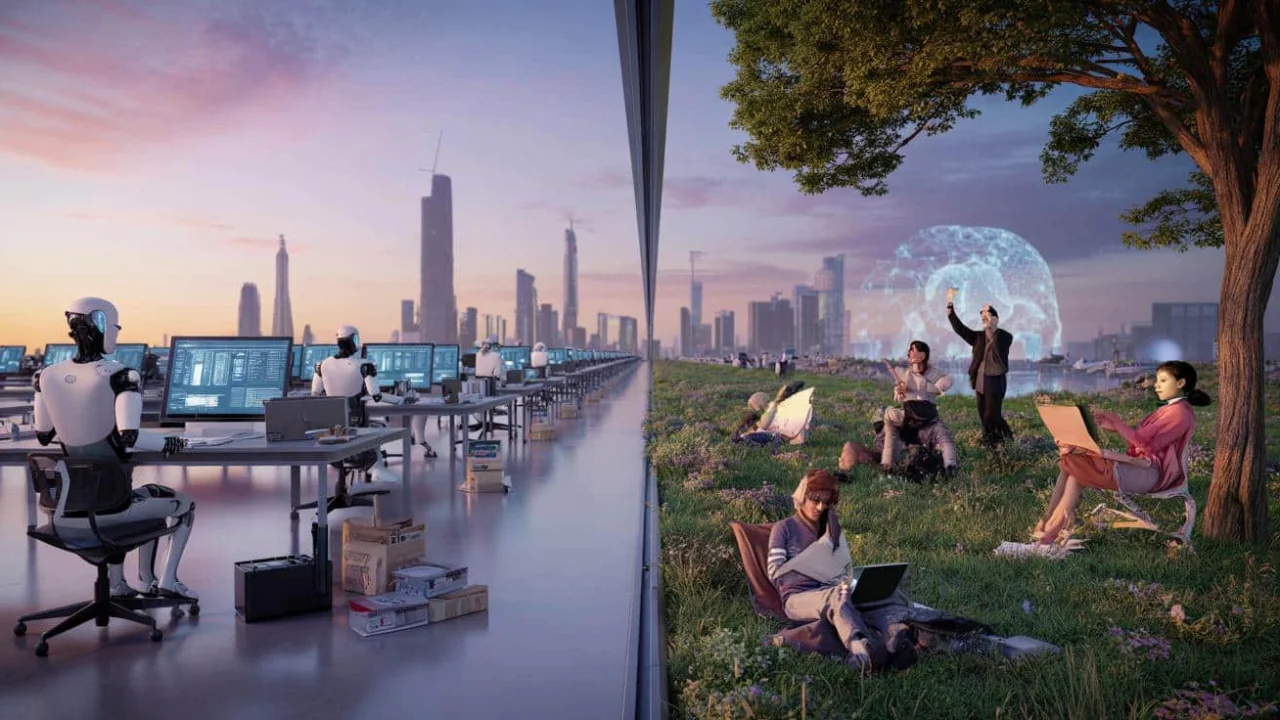
Sarah stared at her laptop screen, watching a chatbot draft an email she would have spent twenty minutes writing herself. The AI finished in thirty seconds, and honestly, it sounded better than her usual attempts. She felt a strange mix of relief and dread wash over her. If a computer could handle her correspondence this well, what exactly was her job going to look like in five years?
That unsettling feeling is spreading across offices, factories, and creative studios worldwide. And now, one of the world’s most respected scientists is saying what many of us are thinking but afraid to voice out loud.
Nobel Prize-winning physicist Giorgio Parisi recently made headlines by agreeing with tech giants Elon Musk and Bill Gates about our automated future. His prediction? AI and robots will transform work so dramatically that we’ll have much more free time. The catch? We might not have traditional jobs anymore.

When a Nobel Winner Backs the Tech Prophets
Parisi isn’t your typical Silicon Valley futurist making bold predictions to grab headlines. At 75, this Italian physicist won the Nobel Prize in 2021 for groundbreaking work on complex systems. He studies the mathematical patterns behind flocking birds, chaotic weather, and economic turbulence.
When someone who understands complex systems at this level says AI and robots will transform work as we know it, it carries serious weight.

“The automation wave we’re seeing could rival the Industrial Revolution in scope,” Parisi explained during a recent presentation. “But this time, machines aren’t just replacing physical labor. They’re taking over cognitive tasks we thought were uniquely human.”
His observations align remarkably with what Musk and Gates have been predicting for years. Musk has repeatedly stated that “no job is needed” in the long run because robots and artificial intelligence will handle almost everything. He envisions a future where people might still work, but more as a creative outlet than economic necessity.

Gates takes a slightly different angle, predicting a three-day work week as AI handles routine tasks. He sees potential for an “AI dividend” that could fund better healthcare, education, and social programs.
The Jobs Revolution Already Happening
The transformation isn’t some distant science fiction scenario. It’s happening right now across multiple industries. Here’s how AI and robots are currently reshaping different sectors:

| Industry | AI/Robot Applications | Jobs Affected |
|---|---|---|
| Legal | Contract analysis, document review | Paralegals, junior lawyers |
| Healthcare | Diagnostic imaging, drug discovery | Radiologists, research analysts |
| Finance | Trading algorithms, risk assessment | Financial analysts, traders |
| Manufacturing | Assembly robots, quality control | Factory workers, inspectors |
| Transportation | Autonomous vehicles, route optimization | Drivers, logistics coordinators |
The changes go beyond simple job replacement. AI systems are now:
- Writing marketing copy that outperforms human-written content
- Diagnosing medical conditions faster than experienced doctors
- Creating artwork that sells for thousands of dollars
- Composing music indistinguishable from human composers
- Managing investment portfolios with better returns than Wall Street professionals
“We’re not just seeing automation of manual tasks anymore,” notes technology researcher Dr. Maria Rodriguez. “AI is handling complex problem-solving that requires creativity, analysis, and decision-making.”
What This Means for Real People
The big question isn’t whether AI and robots will transform work – it’s how quickly and what that means for ordinary families paying mortgages and raising kids.
Some workers are already experiencing the shift firsthand. Customer service representatives watch chatbots handle routine inquiries. Graphic designers compete with AI tools that create logos in minutes. Accountants see software automating tax preparation and bookkeeping.
But the picture isn’t entirely bleak. History shows that technological revolutions often create new types of work even as they eliminate old ones. The internet destroyed many traditional industries but created entirely new job categories that didn’t exist before.
“The question isn’t whether jobs will disappear,” explains economist Dr. James Chen. “It’s whether new opportunities will emerge fast enough to replace them, and whether workers can adapt quickly enough to fill those roles.”
Potential new job categories emerging from AI advancement include:
- AI trainers who teach machines specific skills
- Human-AI collaboration specialists
- Digital wellness consultants
- Automation ethicists
- Virtual reality experience designers
The transition period will likely be bumpy. Some industries will adapt smoothly, while others may face significant disruption. Workers in routine, predictable jobs face the highest risk of displacement, while those in creative, interpersonal, or highly specialized roles may find their skills more valuable than ever.
Governments and companies are starting to discuss solutions like universal basic income, retraining programs, and shorter work weeks. The Nordic countries are already experimenting with four-day work weeks and expanded social safety nets.
“We need to start preparing now,” warns workplace futurist Dr. Lisa Park. “The companies and countries that help their people adapt to this new reality will thrive. Those that ignore it will struggle.”
The timeline for these changes varies by industry and region, but most experts agree we’re looking at significant shifts within the next decade rather than some distant future.
For individuals, the message is clear: stay curious, keep learning, and focus on developing uniquely human skills like emotional intelligence, creativity, and complex problem-solving that complement rather than compete with AI.
The future Parisi, Musk, and Gates envision might sound unsettling, but it could also represent the biggest opportunity in human history to redefine what work means and how we spend our lives.
FAQs
Will AI really eliminate most jobs?
Many jobs will change dramatically, but history shows new types of work typically emerge during technological revolutions.
Which jobs are safest from AI automation?
Roles requiring creativity, emotional intelligence, complex problem-solving, and human interaction are generally more secure.
How quickly will these changes happen?
Most experts predict significant shifts within 10-15 years, though some industries are already experiencing rapid changes.
What can workers do to prepare?
Focus on developing skills that complement AI, stay curious about new technologies, and consider continuous learning as essential.
Could we really have a three-day work week?
Some companies are already experimenting with shorter work weeks as automation increases productivity.
What about people whose jobs disappear?
Solutions being discussed include retraining programs, universal basic income, and new types of work we can’t yet imagine.
About the Author
